Thursday, 26 September 2013

Elephant No. 24: Crackle Effect


I saw this technique while looking at various videos in search of art techniques I've never tried before. This one looked quick and easy—a mantra for me these days—so I thought I'd try it for today's elephant.

Essentially, you paint a thick coat of glue onto a surface, paint over it with acrylic paint, and leave it for several hours. I'm guessing that the glue and the paint dry at different rates, and/or have different surface properties, which is what creates this effect. There are many online tutorials on how to create crackle surfaces for everything from furniture to assemblages, but to see the video I used, click here.

The general idea is to create a flat surface with random cracks, to give something a vintage look. I don't think you're supposed to use this technique to draw things. However, it seemed to me that a crackled elephant would be an interesting experiment, so I decided to try it.

I began by painting two small 6 x 8-inch (15 x 20 cm) canvas boards with acrylic paint in colours that pleased me. I left them to dry for an hour or so, then blasted them with a hairdryer, to make sure they were really dry.


Next, I sketched an elephant lightly over each surface to guide me when I painted on the glue.

For my first elephant, I used a fairly thick coat of glue, keeping more or less to the outlines I'd drawn. Immediate after this, I painted the surface with white paint. The idea is to make make your brushstrokes go in the direction that you want the cracks to form. The thicker the glue, the larger the cracks, and the thinner the glue, the smaller the cracks.


This amorphous-looking quadruped was not exactly what I'd had in mind. I'd clearly drawn something too small and too detailed to accommodate the gloppiness of the glue-paint combination. I tried to fix it by painting on more glue and paint, but I only made it worse.

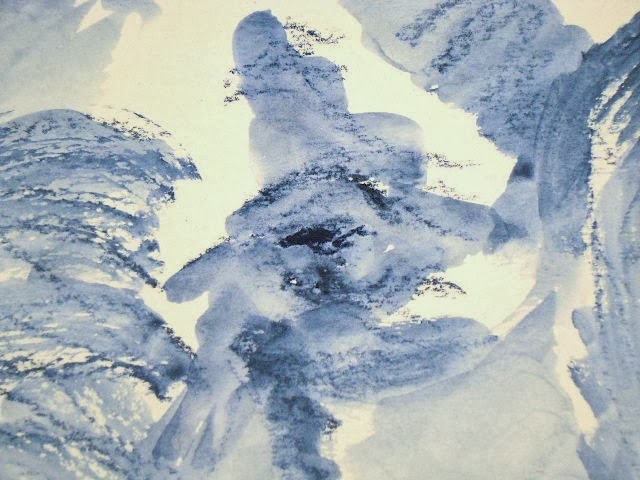
I repeated the process with my second board, this time using a lighter coat of glue and paint over most of the elephant, with thicker areas primarily in the trunk and the edges of the ears. I already liked the look of this one a lot better.


Once I was finished with the painting, I left everything to dry for about three hours. The crackling begins almost immediately, but it needs to dry for at least a couple of hours to ensure that it's set.

And voilĂ ! I liked the effect, particularly in the vertical elephant. The thicker areas of glue and paint did indeed crack more, and the direction of your brushstrokes is indeed reproduced in the pattern of the cracks. I thought it was most interesting in the fine wrinkles across the vertical elephant's head and trunk, and in the edges of his ears.


I had to work a bit more quickly on this than I like, so it wasn't as fun as it perhaps might have been. And because I was trying to create at least some large cracks, I had to add a lot of paint to a lot of glue, making precision somewhat elusive on the first elephant. On the other hand, it's a great way to create the many fine—and very random—wrinkles on an elephant's hide.


Despite my disappointment with the horizontal elephant, and the slightly frantic nature of the technique, I do like the vertical elephant very much. Working this fast also had a hidden bonus: forced to be economical with my brushstrokes, I learned a whole new way of modelling an elephant head.

I would definitely try this again—perhaps on something larger next time, and something I work on in sections, rather than all at once.


Elephant Lore of the Day
Although human-elephant conflict often ends in violence against the offending animals, sometimes the better side of human nature prevails.

In April of this year, a herd of elephants that was fond of nightly crop raids lost one of their calves. The baby elephant fell into a fifteen-foot open well, and couldn't climb back out.

According to P.R. Janardahanan—a homesteader inside the Salim Ali Bird Sanctuary in Goa, India—the herd first entered his fields around 11:00 p.m. The herd was chased away, but by 3:00 a.m. it was back, staying in the area for two hours and resisting all attempts to run it off again. It was on this second foray that the baby fell into the well.

Villagers were roused the following morning by the cries of the baby elephant, and rushed to the scene. Forest officials were called immediately, and brought in earth-moving equipment to gouge out a channel. The calf was then coaxed out of the well by forestry officials and local villagers.

According to the villagers, raids by elephants had become more frequent in recent months, due to drought-like conditions prevailing in the region. Elephants came to the well to drink, and often strayed onto nearby agricultural land, where they caused considerable damage.

However, rather than electrocuting, shooting, poisoning or otherwise harming the baby, Mr. Janardahanan and his neighbours rallied together to save the little calf, who was soon restored to his herd, none the worse for wear.


Baby elephant following his rescue from a well in the Salim Ali Bird Sanctuary
in Goa. The ropes are not restraints, but aids to help pull him free.
Photo: H. Vibhu
Source: http://www.thehindu.com/news/cities/Kochi/baby-elephant-
rescued-from-well/article4595681.ece


To Support Elephant Welfare
Boon Lott's Elephant Sanctuary (Thailand)
Wildlife SOS (India) 
 
The Elephant Sanctuary (Tennessee)

David Shepherd Wildlife Foundation


Wednesday, 25 September 2013

Elephant No. 23: Watersoluble Graphite Blocks


A few days ago, I went to a demonstration of Derwent and Conté products. I received a set of Graphitint pencils at the demonstration, but I liked the big blocks of graphite just as much. So I bought some.


There are many things you can do with these. You can sketch with them, create large swaths of colour, wet the pigment to paint with it, sprinkle dust onto a wet surface, and other stuff I haven't yet discovered.

For today's elephant, I didn't have much time, so I decided I'd just make some kind of big, bold elephant with these blocks. I used big 16 x 20 (40.5 x 50.8 cm) sheets of paper, which is actually something I rarely do. The prospect of dealing with all that blank space generally fills me with dread.

I used the following photograph to guide my drawing.


Asian elephant.
Photo: WWF-Indonesia/Samsul Komar
Source: http://worldwildlife.org/species/asian-elephant

I began by sketching the general outline. I was going to do a faint outline, but got carried away. I really like these graphite blocks, and I never work big, so it was rather freeing.


Since this is a watersoluble medium, I decided to use a water to make the drawing come to life. This was also fun, because the pigment reacts beautifully to the water, making really saturated colours. I also worked fairly loosely, which is a bit unusual for me.


After I had done the initial painting on this, I stared at it for a few minutes, trying to decide if I was finished or not. Something this easy never feels quite finished to me, and if I were working carefully and precisely, I would do far more to it. But I decided to leave well enough alone, as I liked enough things about this drawing that I didn't want to risk making a mess of it.


Since this was so easy, I decided to do another one, using the same image, but a different colour. I wasn't entirely happy with my interpretation of the photograph the first time, so this was an opportunity to try again.

I sketched the elephant again, this time liking the form a little better.


Using a fairly saturated paintbrush, I moved the pigment around.

It looked pretty good to me, but I thought I'd also try wetting some of the areas, grating the graphite block onto the wet surface to make it bloom. I had this handy-dandy block grater, made specifically for this purpose, but you could probably also use something like a nutmeg grater or a piece of metal window screen.


Liking the effect right away, I repeated it in a few other parts of the drawing. Then I decided to leave well enough alone.


I liked both of these, for different reasons. I also like these blocks, like the grater, and actually enjoyed drawing big and bold for a change. This felt more like play than any drawing I've done yet, so I'll definitely be trying this again sometime.


Elephant Lore of the Day
White elephants found in the forests of Thailand are regarded not as animals, but as honorary human beings. Before being accorded this status, they must be officially recognized by royal priests; but, once recognized, they are given the rank of high courtier. Their names are preceded by the title phra-sarith which means "excellent white one."

As late as the early twentieth century, when a white elephant arrived in the capital, the King of Thailand would attend prayers of welcome, which were chanted by ten priests. On the following morning, the King would also be on hand for the ceremonial bathing of the elephant, as well as a Brahmin ceremony intended to bring good luck. At this time, the King would also give the elephant its name.

In the evening, white elephants are sung to sleep by Brahmin priests. In earlier days, a singer and master musician would serenade the elephant to sleep, and the last musician to play for a white elephant considered it a great honour.

As mentioned in my original Elephant a Day blog, "white elephant" as a synonym for "thing I don't want" is a concept that originates in Thailand. Because many Asian countries venerated albino elephants—meaning that they required special housing, food and care—they were expensive to keep. One of Thailand's kings thus devised an interesting way of punishing nobles who crossed him. Instead of tossing the offender in prison, he would present them with a white elephant: a gift sure to result in financial ruin.

To read more about white elephants, click here.


White elephants aren't actually white but a sort of pale pinky-grey.
Thailand's request to borrow this Burmese white elephant to display in the
Chiang Mai Zoo was politely declined by Burmese officials.
Source: http://www.thaivisa.com/forum/topic/647873-myanmar-turns-down-
thai-request-for-white-elephant/


To Support Elephant Welfare
Boon Lott's Elephant Sanctuary (Thailand)
Wildlife SOS (India) 
 
The Elephant Sanctuary (Tennessee)

David Shepherd Wildlife Foundation


Tuesday, 24 September 2013

Elephant No. 22: Feature Artist David Shepherd

Evening in Africa, 1995
David Shepherd (1931– )
Source: http://www.davidshepherd.com/davidshepherd-eveninginafrica.html


My friend Terena Gill pointed me to the art of David Shepherd, who is well known for his paintings of wildlife—particularly elephants.

Born in 1931, David Shepherd is not only a highly successful artist but also an outspoken conservationist. In fact, after finishing school, he left England right away for Kenya, where he hoped to become a game warden. Unable to find a warden job at the time, he returned home, and began training as an artist. In addition to producing prints and paintings of wildlife, he has also painted trains—another passion of his—and portraits, including one of the Queen Mother.


Kilaguni Babies, 1995
David Shepherd (1931– )
Source: http://www.davidshepherd.com/davidshepherd-kilagunibabies.html

Shepherd's interest in conservation was cemented by a trip to the African bush, where he came across a poisoned waterhole, surrounded by dead zebra. As a passionate advocate for wildlife, he has been quoted as saying, "You can always build another steam loco, but you can't build another tiger."


Happy Time, 2005
David Shepherd (1931– )
Source: http://www.davidshepherd.com/davidshepherd-happytime.html

He is also founder of the David Shepherd Wildlife Foundation, which supports numerous conservation projects in Africa and Asia. In 1979, he received the Order of the British Empire "for services to the conservation of wildlife" and was made a Commander of the Order of the British Empire in 2008.

As an author, he has several books to his credit, including the autobiographical The Man Who Loves Giants. He has also been the subject of a number of documentaries.

To read more about his life and work, click here.


David Shepherd in his studio.
Source: http://www.davidshepherd.com/davidshepherd-portrait-painting.html


Elephant Lore of the Day
This is a truly heartbreaking story of a baby elephant held captive in Sumatra. If your heart breaks easily when it comes to animals, best to stop here.

In northern Sumatra, logging and deforestation are wreaking havoc on animal habitat, bringing wild creatures into ever closer contact with humans. Elephants are particularly destructive, given their size, so one day palm oil farmers decided to take their revenge.

Capturing a baby elephant nicknamed Raja, villagers kept him chained, neglected and starved—to say nothing of his cries for his mother. Raja had become separated from his herd, which was blamed for recent destruction on a palm oil plantation, and was essentially held for ransom.

Multiple efforts were made by activists and international animal welfare organizations to free little Raja. Unfortunately, the people who held him refused to release him until they were paid what they felt to be fair reparations for recent elephant depredations.

According to activists, those who held Raja captive broke a number of Indonesian laws aimed at protecting wildlife, including laws requiring adequate sustenance of captive animals.

Fed only rarely—and often tauntingly—Raja ultimately sickened and died alone, chained to his tree. There is no happy ending, except the hope that somewhere there is a heaven for elephants, and that Raja is now free.

To read more, click here.


Little Raja was found wandering in a palm oil field, and was captured and
held for ransom. He later died.
Photo: Ulet Ifansasti/Ecological Response Unit
Source: http://www.dailymail.co.uk/news/article-2351609/The-terrible-fate-
Raja-baby-elephant-chained-held-hostage-angry-mob-
An-image-haunt-story-enrage-you.html


To Support Elephant Welfare
Boon Lott's Elephant Sanctuary (Thailand)
Wildlife SOS (India) 
 
The Elephant Sanctuary (Tennessee)

David Shepherd Wildlife Foundation

Monday, 23 September 2013

Elephant No. 21: Cloth Doll


I came across a magazine at the bookstore last week called Prims, which features interesting folk art dolls and animals by various artists. Although there were no elephant dolls in the magazine, I bought it anyway—as much for the inspiration it provided as for the technical information it contained.

I began by drafting a pattern for myself. My pattern was admittedly eccentric, but I was pretty sure it would work well enough for what I had in mind. On the other hand, I've never made a cloth doll before, so I'm not sure why I thought I could make one based on some pictures in a magazine.

I began by cutting out everything in unbleached muslin.


Next, I stitched up the following parts: body, arms, legs and trunk. I originally had another idea for the ears, so didn't stitch them until later.


I sewed the arms and legs in tubes, then flattened them so that the seams would be on the inside of the body, where they would be seen.


For the trunk, I inserted a length of wire—bent over itself on both ends to keep it from poking through.


Finally, I stuffed everything firmly.


I assembled everything by by whipstitching all the openings, attaching the legs flat, and the trunk and arms as you would an inset sleeve.


Now that everything but the ears was attached, I rethought my original plan for the ears, which had been to leave their edges raggedy. Instead, I stitched them on the sewing machine, turned them, and attached them with whipstitching.


I thought this was fun as is, but I wanted to give it more of a ragdoll look, so I gave the whole thing a light wash of grey acrylic paint. I let everything dry for about half an hour, then painted pink inside the ears, at the tip of the trunk, and on the toenails.


I hadn't decided yet whether I would paint eyes or add beads or buttons, so I left that decision for later, once the personality of the elephant became a little more clear.

Now came the fun part: dressing up the elephant and giving it a personality. My original idea was to stitch or glue things to the elephant's body to give it a sort of folk art look. I tried tying on ribbons and bits of felt to create both boy and girl elephants, but nothing really pleased me. Then I realized that it was because the elephant didn't have the folk art look I had expected. I changed gears and decided instead to dress the elephant up like a more conventional doll.

I drafted a sleeveless dress pattern, cut it out of unbleached muslin, seamed it up the back, and hand-hemmed all the raw edges. I must be insane.


Because I'd made the dress of plain muslin, I decided it should now be handpainted. I stuffed it with paper towels, and painted a striped design, not caring much about precision and paint bleed. I let that dry for about an hour, then used the hairdryer on it to make sure it was really dry. To finish the fabric design, I added some abstract flowers, and left it to dry again.


Once the dress was dry, I began embellishing it with ribbon and buttons. I'd put the dress on the elephant to give me a better sense of proportion, but was careful not to stitch the dress to the elephant.


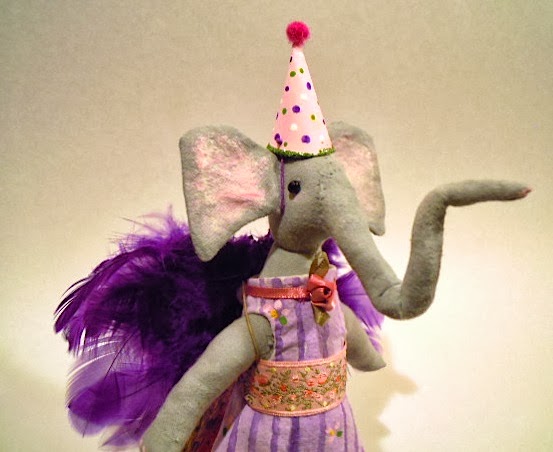
I decided now that the elephant looked like she was going to a birthday party, so I gave her angel wings, looped over her shoulders, and a party hat.

For the wings, I used this tutorial by Milky Way Photography for inspiration. I decided her wings should be purple.


For the hat, I used this template by First Palette to give me the general shape.


This is what she looked like with just the party hat. Pretty cute.


And this is what she looked like with her wings. Also cute, I thought.


It took me hours to make this, partly because I was drafting my own patterns, and partly because of the amount of hand-stitching involved. That being said, I love this little elephant, and might even make another one sometime.


Elephant Lore of the Day
In August of this year, six-tonne Anarkali the elephant got into trouble when she went for a bath in the lake outside Amer Fort in Jaipur, India.

Anarkali is helped back to shore, Jaipur, India, 2013.
Photo: ©Dainki Bhaskar/Barcroft India
Source: http://www.dailymail.co.uk/news/article-2391226/Indian-rescuers-
save-tonne-ELEPHANT-drowning-lake.html


Wandering away from the shore on her own, she became trapped in a pocket of deep water, and was in danger of drowning. Confused and afraid, she seemed unable to figure out how to free herself.

Her owner quickly boarded a motorboat to the stricken elephant. Climbing onto her back, he managed to help her free herself. Anarkali was then guided by her owner and two small boats to the shore, where she was greeted by scores of tourists.

To read more, click here.

Anarkali is greeted onshore by scores of onlookers.
Photo: Dainik Bhaskar/Barcroft India
Source: http://www.dailymail.co.uk/news/article-2391226/Indian-rescuers-
save-tonne-ELEPHANT-drowning-lake.html


To Support Elephant Welfare
Boon Lott's Elephant Sanctuary (Thailand)
Wildlife SOS (India) 
 
The Elephant Sanctuary (Tennessee)