Showing posts with label clothing. Show all posts

Sunday, 27 October 2013

Elephant No. 55: Rain Poncho


It's been cold and rainy around here lately, so for today's elephant I thought I'd draw something on a plastic rain poncho. Never owned one of these, even as a little kid, but from the package it looked like the perfect shape for an elephant design of some sort.

This is the rain poncho I got, purchased from a dollar store for under two dollars. Yellow would have been my first choice, but I didn't like any of the yellows. The plastic on these is also really thin, so I thought red might make a better canvas for an elephant design.


At first, I'd intended to draw only on the back, thinking that I'd use the hood area to give the elephant a crown. Then I decided to do a front-facing elephant on the front, and a retreating elephant on the back, with the crown only on the back.

To give myself at least some idea as to what all this might look like, I made a couple of rough sketches.


Although it's a bit chilly here today, I decided to work outside. I spread the poncho across my garden fence, and stuck it to the wood with push pins.


I sketched the front-facing elephant lightly with a permanent black marker. Unfortunately, it was so light that it didn't photograph at all.

Next, I went over the lines with a heavier marker and added some loose shading. I also made the elephant a bit wider than natural. My thinking was that, if this is ever worn, it will gather in the middle, making the elephant slimmer.


Since I'd wanted a sketch-like graphic design on the poncho, this looked good enough to me, so I flipped it over to do the back. The front design showed through the thin plastic, so I used the top of the head, the tops of the ears and the lower part of the body as a guide for the drawing on the back.
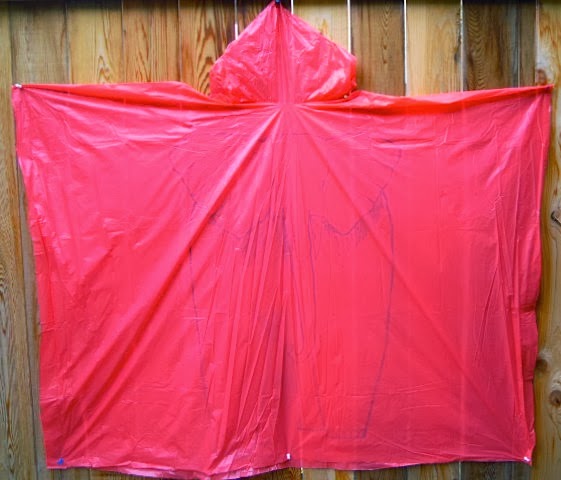


And this is what the back looked like when it was final.


I didn't want anything too realistic, so I was pretty happy with this. It's a bit distorted when flat, but when I put it on a hanger and let the wind take it, the ripples almost made it look like the elephant was walking with its ears flapping, which I found kind of cool.

I'll probably never wear this, but for two dollars, a magic marker and less than an hour of my time, it was definitely worth it.


Elephant Lore of the Day
Interestingly, elephants can hear rain that is falling miles away.

In 2002, researchers plotting elephant highways along the southern edge of the Sahara Desert (the Sahel) discovered that some elephant migration routes are immense. Each year, for example, elephants in Mali follow a circular migration route covering a whopping 450 kilometers (280 miles). The reason is water.

Because elephants cannot survive long without water, they sometimes travel as much as 100 to 150 kilometres (62 to 93 miles) a day from one water hole to the next. And because arriving at a water hole that has already dried up could mean the death of the herd, desert elephants like the ones in Mali have learned to "hear" where rain is falling.

According to Iain Douglas-Hamilton of Save the Elephants, rain has a very low infrasonic signal. This signal, although inaudible to humans, is easily heard by elephants, even over long distances. As soon as elephants hear rain, they will head to that spot within 24 hours. 

Sadly, traditional elephant migration routes are under increasing threat. With the advent of irrigation and agriculture, the region is changing, and nomadic peoples who once viewed the elephant as a talisman now see it as a pest. To make matters worse, permanent sources of water set up to help the people of the Sahel are also proving a tempting source of water for elephants—with a predictable rise in human-elephant conflict.

To read more, click here.

 
Desert elephants at a water hole.
Source: http://wakpaper.com/id137821/two-adult-elephants-and-their-baby-
elephant-in-desert-found-a-water-1600x1200-pixel.html


To Support Elephant Welfare
Boon Lott's Elephant Sanctuary (Thailand)
Wildlife SOS (India) 
 
The Elephant Sanctuary (Tennessee)

David Shepherd Wildlife Foundation

Monday, 30 September 2013

Elephant No. 28: Rain Boots


Once I decided to paint an umbrella, I thought I should try decorating a pair of rain boots. I know there are rubber-based spray paints you can buy to paint on rubber boots, but I wanted to draw on the boots with permanent markers.

Unfortunately, it was impossible to find anything useful about drawing on rubber boots with markers—this page was the closest I came to anything helpful. And this page had a fun idea for a gold-leaf leopard pattern, but it wasn't what I had in mind.

Even sites devoted to permanent markers refused to suggest using them on rubber boots. However, there were so many sites devoted to telling you how to remove markers from rubber that I figured the markers must stick quite well. And when I read that it might be possible to lighten markers on rubber with vigorous effort, but not entirely remove them, I thought, "That's what I want to hear."

I started by purchasing a pair of inexpensive rain boots in bright yellow. You wouldn't believe how hard it is to find a pair of plain rain boots these days. They're all paisley and plaid and frolicking animals (but no elephants). I finally found these in the kids' section of a discount shoe store. Luckily, I have small feet, so these actually fit me. These cost me $10, which was a major bargain in comparison to every other pair of rubber boots I saw.


I started by washing the exterior to remove any oil or dust, dried them off with paper towels, and let them air-dry while I began figuring out a design. The main thing I wanted to do was work around the physical structure of the boots. They had various ridges and lines, and a circle in the middle of each side which looked like the perfect shape for an elephant with a curled trunk.

I sketched onto the rubber with a black non-waterproof marker, trying various things, washing it off, and drawing again. I panicked briefly when the marker didn't want to wash off, then used soap as well as water, and it was fine. These boots were a sort of porous, gummy rubber, which also seemed to scratch easily.


Once I was more or less satisfied with the design, I took a deep breath and drew onto the boots with a medium-point permanent marker. Knowing this was going to be permanent, I was fairly careful as I drew. Then I realized that I could scratch the marker off the surface with my fingernail if I did it fairly soon after I'd drawn it. The longer you wait, the more the ink sinks into the rubber, so it's best to scratch things off early in the process, if you're going to do it at all.


In some of the blanker areas, including the toes, I added dots to relieve some of the emptiness. I decided I'd better stop there, or they would get quite busy to look at. They were already fairly busy, but I liked them well enough.


I added a sort of abstract grass around the base as well.


I also thought briefly about adding colour with some of the other markers I had, but I thought that might add more visual chaos than I wanted. I also liked the look of simple black outlines on yellow boots, and the black marker matched the soles nicely.

Once I was finished drawing, I gently washed off the water-soluble pen with soap and water. I used dish soap and my bare hands, rather than anything abrasive. The marker is still fairly delicate at this point, so I didn't want to risk scratching it off.

The hardest part of this process was figuring out a design. Working around the various structural areas of the boot is challenging, and elephants don't necessarily lend themselves to many of the shapes I had to work with.

One thing I noticed, after it was too late, was that the elephants on the sides are facing forward on one boot, and backward on the other. Don't know how that happened, but I kind of like the asymmetry of it.

I wasn't sure what I thought about the boots right after I was finished. However, now that they've been sitting by themselves for awhile, I quite like the graphic look of them. In fact, I may even try another pair at some point—if I can find an inexpensive pair of boots to decorate, that is.


Elephant Lore of the Day
Given that elephants are endangered in most parts of the world, you'd think that any rise in their numbers would be cause for celebration. Not so in one part of southwestern India.

In the Alur forest of southern Karnataka, the elephant population has grown by 70% over the past 10 years, from 27 to 45. This has led to protests from local farmers, and demands that the elephants be relocated to keep them from damaging crops and killing people.

Unfortunately, the answer is not that simple. Part of the problem is that, as farming expands, the land available to elephants shrinks. The average elephant requires 3-5 square kilometres of forest in which to forage. Multiply that by 45 elephants, and you need 135–225 square kilometres of forest for this single group.

Nor do elephants take kindly to being relocated. Elephants have an uncanny ability to memorize their entire range, and will often find their way back to areas they like—sometimes within a few days.

Although governments everywhere are keenly aware that deforestation remains the primary cause of human-elephant conflict, most lack the will to veto projects that destroy animal habitats. It is doubtful that the problem will ever be resolved, until the rhetoric changes from "trouble-making elephants" to "trouble-making humans" and forest conservation takes precedence over farming and engineering projects.


Asian elephants emerging from Athirapally Forest, Kerala.
Source: http://www.8thingstodo.com/athirapally-vazhachafalls-in-thrissur-kerala


To Support Elephant Welfare
Boon Lott's Elephant Sanctuary (Thailand)
Wildlife SOS (India) 
 
The Elephant Sanctuary (Tennessee)

David Shepherd Wildlife Foundation

Thursday, 19 September 2013

Elephant No. 17: Inktense Pencils on Fabric


I saw this technique a couple of months ago at an art quilt show featuring, among others, my friend Marie-France Gosselin. Marie-France has a fantastic colour sense, and seems game to try almost any medium on her art quilts. So, when she spoke of using Inktense watercolour pencils on fabric, I decided to give it a try.

For those of you not familiar with Inktense pencils, they're technically like other watercolour pencils, but give you much more saturated colours than any other watercolour pencil I've ever tried. I'm a big fan.


Marie-France mentioned using the Inktense colour blocks as well, so I bought six of them yesterday at a local art store.


I thought about painting on a simple piece of fabric, then remembered that the dollar store has canvas artist aprons for two or three dollars. So I bought one.


There are many different opinions out there on how to go about painting on fabric with Inktense pencils:
• Use unwashed fabric to keep the pigments from bleeding. Which is fine unless you want the pigments to bleed.
• Use textile medium to make the colours more permanent; although textile medium makes the fabric more stiff.
• Ironing the piece afterwards makes the colours permanent; no need for textile medium.
• Using only water guarantees that the colour will fade when washed.
• Using a 50/50 blend of water and textile medium is almost as good as 100% textile medium.
• Water spreads the pigments better than textile medium.

I admit that my head began to spin, so I decided on the following for my piece:
• 50/50 textile medium and water
• Iron it after it dries.
• Wash it sparingly and on the delicate cycle.

To see one artist's tests with different fabrics and liquids, click here.

There are also many different ideas on how to use Inktense pencils and blocks. I liked this tutorial, produced by Derwent, the company that makes Inktense.

I laid the apron on top of a plastic craft sheet, then lightly sketched an elephant on the main part of the apron, using a black Inktense pencil. I followed this by going over the main lines with a violet Inktense pencil.


I tried a tentative bit of shading with my 50/50 water-textile medium and a small, flat brush. You need fairly stiff brushes to work the ink into the fabric.


I didn't have any specific idea about where I was going to go from here, so I just started playing with colour.  I added the following colours in this order: blue, green, orange, yellow and red, with a bit of black for the eyes and a bit of white on the tusks. As I worked, I occasionally painted over the pigment to move it around, sometimes drew over the damp areas with a pencil, and used the blocks to create larger areas of colour.


I also thought the non-elephant part of the apron looked too blank, so I added dots with the same colours (except black and white) across the empty areas.


A few tips if you decide to try this:

• Saturating the colour will lighten it considerably, as it would if you added a lot of water to watercolours or acrylics. It will also cause the pigment to spread and bleed.
• In addition to drawing on dry fabric, then painting over it with water and/or textile medium, you can also dip the pencils or blocks directly into the liquid and draw onto the fabric. This will generally give you more definition.
• Similarly, you can take a dry pencil or block and draw directly onto the damp fabric. This gives you more definition than spreading the pigment with water, but less than dipping the pencil or block into water and then drawing with it.
• As long as the paint is damp, it remains smudgeable. I ended up with quite a lot of pigment on the side of my dominant hand, but luckily didn't smudge things too much.
• The more colours you add, the more murky it can become. This can be fixed, however, by dipping a lighter colour of pencil or block into your liquid, then using it heavily on the area that displeases you.

I'm sure I could have gone much bolder and brighter with my colours, but I'm always afraid I'll go too far, so I left it at this. After letting it dry, I ironed it on both the reverse and the front, using a very hot iron.

I liked this technique a lot. You can get an immense range of effects, from fine lines to washes, and the pencils come in a nice range of colours. It's not a terribly messy activity, and a design as simple as this works up quickly.

I painted on fabric with acrylic paint in my original blog, but I think this might just replace that technique for any future fabric-painting adventures.


Elephant Lore of the Day
Like most sneak thieves, elephants prefer dark nights for their raids.

Scientists studying elephant herds in Africa have discovered that elephant raids on local crops vary with the lunar cycle. Having learned that farmers can see them under a full moon, elephants have apparently changed their behaviour to avoid moonlit nights.

The research was undertaken near five villages on the northern boundary of Tanzania's Mikumi National Park, where elephant raids were common. Surprisingly, it was discovered that elephants have altered their behaviour to avoid encounters with humans. Not only did they raid only at night, but were also far less likely to go anywhere near the villages when the moon was at its fullest.

Many animals have biological clocks that are attuned to lunar cycles, and many avoid the full moon to avoid being eaten. Elephants, however, appear to have taken it one step further, having learned that if they plunder fields on the darkest days of the month, they are more likely to avoid being hassled by angry farmers.

To read the full story in the online Daily Mail, click here.


Elephants under a full moon.
Photo: ©Konrad Wolhe/MindenPictures/Corbis
Source: http://www.dailymail.co.uk/sciencetech/article-2380585/Elephants-
like-dark-night-crafty-crop-raids-Animals-avoid-moons-hunting-food.html


To Support Elephant Welfare
Boon Lott's Elephant Sanctuary (Thailand)
Wildlife SOS (India) 
 
The Elephant Sanctuary (Tennessee