Showing posts with label wood. Show all posts

Wednesday, 30 October 2013

Elephant No. 58: Skelephant


I bought a paint-your-own wooden skeleton weeks ago, thinking I could turn it into some kind of skelephant—maybe even one that would glow in the dark. Since Hallowe'en is tomorrow, I decided to finally make this for today's elephant.


The wooden form was obviously meant to be a human skeleton, so I figured it needed at least a bit of tweaking to make it into an elephant. To make sure I didn't completely embarrass myself, I thought I'd look up x-rays of elephants online. Then I remembered that it's impossible to x-ray an entire elephant, so I decided instead to look at images of actual elephant skeletons—particularly the skull.


I did remember that elephants have large holes in the centre of their skulls, so I planned to cut something out of the centre of my wooden skeleton's head. And, since teeth are usually part of a skeleton, I planned to add a couple of wooden tusks, cut out of thin plywood. With visions of x-rays still in my head, I thought briefly about adding a ghostly trunk, then remembered that this was a skeleton, not an x-ray or ectoplasmic elephant.


3-D elephant skull model.
Source: http://www.turbosquid.com/3d-models/3ds-max-elephant-skull-
skeleton/715292


I began by placing plain white paper over the wooden skeleton, in order to figure out what the tusks should look like. I also traced out the void in the forehead. I used this image to guide my drawing of the central hole in the skull. There wasn't a lot of room in the forehead of the wooden shape for an additional hole, so it's definitely not to scale.

I'm pretty good with a jigsaw—my only possible claim to power-tool fame—so I cut out the void and the tusks with my trusty jigsaw. I then sanded the edges of everything to clean them up. I hate sanding, as you can see by the many raggedy edges that remained.


I painted everything with inexpensive white acrylic paint next, and let it dry. I hadn't thought about the fact that I'd have to paint all four "sides" of this three-dimensional form. Sigh. I painted everything with one coat of white paint, and put two coats on the front.

I glued the tusks to the skeleton form with a glue gun. By now, many of you will know that I also hate glue guns. At least I didn't burn myself today.


Now, to give the whole thing an eerie look, I decided to paint it with glow-in-the-dark paint. This stuff was much more expensive than I had expected. For this
207 ml/7 oz. jar, it was about twelve dollars. Add that to the six dollars it cost me for a 2 x 2-foot (60 x 60 cm) piece of 1/4-inch (0.6 cm) plywood to make a couple of measly tusks, and the two dollars for the elephant, and this was one of the more expensive elephants I've made.


I had originally thought I'd be painting this to look like an x-ray, so I had visions of carefully painting to make the bones look slightly dimensional. You can imagine how happy I was to remember that a skeleton is just bleached white bones. So I just painted everything the same. I wasn't sure if thicker layers would glow more, but it didn't really matter.

The instructions on the can say to paint two coats for best effect, leaving 45 minutes between coats. I think they tell you that because it's so hard to see the paint on the surface that they want to make sure you've actually covered everything. I was also not very careful, more or less glopping it on and not worrying about nice brushstrokes.

I reassembled the whole thing with twists of black wire, and left it to dry for about an hour. And then, for the moment of truth.  I put this outside in daylight for about an hour, then brought it inside to see if it really would glow in the dark. Never having painted glow-in-the-dark paint on anything, I wasn't sure what to expect. Well . . . nothing.

Thinking I needed to add more paint, I put on two more really thick coats, let it dry, then stuck it under a bright bulb for a couple of hours. Still nothing. It does have a very faint glow, but it's so faint that my camera literally couldn't pick it up at all. Most disappointing.

The instructions say it needs "several hours" in light to charge up, but this has been in either daylight or artificial light all day, so I'm not sure why it doesn't work. If I'd had glow sticks on hand, I probably would have broken a couple open and doused the skelephant in whatever scary substance is inside your average glow stick.

I still had the skeleton itself, however. It's nothing like a real elephant skeleton, but if you could get an elephant to stand up, and ignored the fact that an elephant's eyes are normally on the sides of its head, this might squeak by. Or end up reminding you of a human skeleton with a severe head injury and a handlebar moustache. Or a walrus.

I'm not sure if this skelephant will be part of tomorrow's Hallowe'en decorations, and I'm peeved that it doesn't glow in the dark, but I may sand it down at some point, paint it white again, then decorate it as a Day of the Dead skelephant. Kind of wish I'd thought of that in the first place.


Elephant Lore of the Day
Because I'm not likely to do too many elephant skeletons, I thought I'd bring back a bit of elephant lore from the original Elephant a Day blog about elephant skulls and the myth of the Cyclops.

An elephant's head weighs literally hundreds of pounds. To support this weight, there are extra muscles along the neck. Interestingly, an elephant's skull is also filled with tiny air pockets, just like the bones of birds, to keep it relatively light.

Some palaeontologists believe that the Greek myth of the one-eyed Cyclops arose from discoveries of the skulls of dwarf elephants on Cyprus, Crete and Malta. These elephants had skulls roughly the size of humans, but with a large cavity in the middle of the head. Because these early Mediterraneans may have lacked direct knowledge of elephants, is is conceivable that they believed they were looking at a humanoid skull with a large central eye socket.


Skull of dwarf elephant on display at
the Hellabrun Zoo, Munich, Germany.
Photo: MaxM
Source: http://en.wikipedia.org/wiki/File:Dwarfelephant.jpg

To Support Elephant Welfare
Boon Lott's Elephant Sanctuary (Thailand)
Wildlife SOS (India) 
 
The Elephant Sanctuary (Tennessee)

David Shepherd Wildlife Foundation

Friday, 25 October 2013

Elephant No. 53: Rhinestone Box


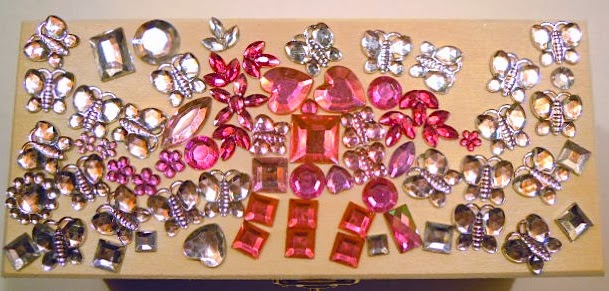
I'm a bit of a magpie, in that I like sparkly things, so when a package of multicoloured acrylic rhinestones caught my eye a few days ago, I had to bring it home to make an elephant. What kind of elephant, I had no idea, but I figured I could glue them to the top of a box. So I bought a box, too.


The rhinestones were all in different shapes, sizes and colours, so I wasn't quite sure how I was going to make a recognizable elephant that stood out from its surroundings. My original idea was to make a multicoloured elephant against a multicoloured background; unfortunately, when I tried that, it was total visual chaos.


I decided to sort the colours to see what I had to work with, and discovered that the bulk of the rhinestones were either pink or red. So I defaulted to a pink elephant, thinking that I could form a background around it later.

I laid out the rhinestones on the box in an abstract elephant pattern, and ended up with the design below. I liked it well enough, and was almost out of pink rhinestones anyway, so I decided to go with this for my final design.


Easier said than done. Each time I picked up a rhinestone to add glue, I dislodged everything around it. It was a good thing I had the photo above as a reference, or I would have been lost. It might have been easier to create an elephant organically, glueing as I went; but I was now rather attached to the design, and was determined to re-create it on the box.


After about an hour, I'd more or less reproduced the original design. I left it to dry for a bit while I pondered what to do about the background. I tried a number of things. First, I outlined the elephant with clear rhinestones, adding other colours to the areas beyond. It was pretty hideous, and also impossible to discern the elephant in the midst of it all.

Then I thought that maybe using just clear rhinestones would work. It didn't, as you can see from the photograph below. It was just too much sparkle, and the elephant got lost again.


I went back to the original, which is just an eccentric pink elephant on a wooden box. I had expected to end up with something a little more fancy, but I still kind of like this bizarre little creature.


Elephant Lore of the Day
In Ayutthaya, Thailand, there is an elaborate monument to war elephants, created by artist Khun Khaimuk, Thailand's first professional female sculptor.

The monument features four life-sized bronze elephants, each facing one of the cardinal directions. Kitted out in full battle gear, the elephants are accompanied by mahouts, warriors and guards. 


Burmese war elephant sculpture by Khun Khaimuk (1938–1996).
Photo: Tricky Vandenberg
Source: http://www.ayutthaya-history.com/Historical_Sites_
WarElephantsMonument.html


Thailand's war elephants were normally equipped with a special howdah, manned by an aristocratic warrior. Each elephant was also surrounded by four noblemen, who took up positions near each of the elephant's legs—a formation that has been reproduced in the monument at Ayutthaya. 

In battle, the goal of a Thai war elephant was to destabilize its adversary by catching and holding the opposing elephant with its shoulder and tusks. This helped to manoeuvre the warrior into the best position from which to attack the enemy.

To read more, click here


Burmese war elephant sculpture by Khun Khaimuk (1938–1996).
Photo: Tricky Vandenberg
Source: http://www.ayutthaya-history.com/Historical_Sites_
WarElephantsMonument.html


To Support Elephant Welfare
Boon Lott's Elephant Sanctuary (Thailand)
Wildlife SOS (India) 
 
The Elephant Sanctuary (Tennessee)

David Shepherd Wildlife Foundation

Thursday, 10 October 2013

Elephant No. 38: Excelsior


I came across a bag of excelsior yesterday in a dollar store, and thought it would be an interesting thing to try for today's elephant. As children, my siblings and I loved it when crates arrived from overseas, because they were always crammed with excelsior. We usually ended up climbing in and out of the crates until we looked like scarecrows, at which point our mother usually asked us to kindly remove ourselves and go play somewhere else.

The bag calls this "wood hair" which sounds very unappealing to me, and most parts of the world call this "wood wool". I prefer the much prettier American term—originally a brand name—so I'm going to stick with that.


I started by flopping the contents onto a piece of white bristol board. Not sure what to do from here, I began tugging it into something that might resemble an elephant.


I realized right away that, if I pulled too hard, I was going to separate the strands and end up with something that wouldn't really hold together. This is stuff that you can't push back together once it's been separated. Working gently on various sections, I teased out a long trunk, a small tail, and some legs.

The head was a bit harder, because I wanted to create the impression of an ear, but didn't want to pull off a chunk excelsior and plop it on top. I also tried to smush the excelsior around to model the body of the elephant a bit, but it's not a terribly mouldable material.

Given that I didn't really feel like making an elephant today, I was happy that this was quick and easy. Not as quick as I'd expected, but also not as stupid as it could have been. If I were to keep this, I think I'd spray it with glue and remould it slightly, then add some alcohol ink to liven it up and give it a bit of definition. But for today, this works for me.


Elephant Lore of the Day
I don't usually write about the politics of the ivory trade and elephant poaching, because there are many who do that much more effectively than I ever could. However, I thought this story was interesting, sent to me yesterday by Sylvie Morel.

Speaking at the International March for Elephants last week, Khamis Kagasheki, Tanzania's Minister for Natural Resources and Tourism, suggested a new tactic: shoot poachers on sight. Faced with a record number of elephant-poaching incidents in his country, Kagasheki suggested that only the strictest of punishments had any hope of curbing the trade in illegal ivory.

Calling poachers "merciless people who wantonly kill our wildlife," Kagasheki also remarked that they "do not hesitate to shoot dead any innocent person standing in their way"—including game wardens trying to protect Tanzania's wildlife.

Although conservationists around the world are struggling to curb the poaching of elephants and rhinos in particular, many took issue with the idea of killing poachers—although not with the idea of harsher punishments. Noting that it is sometimes difficult to determine who actually killed the animal, conservationists suggested that killing poachers might result in increased violence, and that high-tech solutions might be more effective in the long run.

In his address, Kagasheki announced that the Tanzanian National Assembly will be reviewing a new anti-poaching bill in November. And perhaps not before time. As home to the Serengeti National Park and game reserve, Tanzania has one of the largest elephant populations in the world.

In recent years, however, its herds have been decimated by poaching. It is estimated that poachers kill 30 elephants each day in Tanzania and, in every year from 2009 to 2011, 37% of all seized elephant tusks originated in Tanzania, making it the world's leading exporter of illegal ivory at the time.

To read more of the original story, click here. To read an October 2012 National Geographic Magazine article on "blood ivory", click here.


A single tusk from one of these elephants in Kenya's Tsavo National Park
can fetch $6,000—enough to support an unskilled Kenyan worker for ten years.
Photo: Brent Stirton
Source: http://ngm.nationalgeographic.com/2012/10/ivory/stirton-photography


To Support Elephant Welfare
Boon Lott's Elephant Sanctuary (Thailand)
Wildlife SOS (India) 
 
The Elephant Sanctuary (Tennessee)

David Shepherd Wildlife Foundation