Saturday, 9 November 2013

Elephant No. 68: Mini Babybel Cheeses


This idea was sent to me by Annie Carruthers, who always finds great ways to help me play with my food. Although I shaped things with the red wax on Babybel cheeses when I was a teenager, I'd never thought of cutting shapes into it. To see the original inspiration, click here.

I bought this small string bag of mini Babybel cheeses at the grocery store. I bought only the ones with red wax, as they provide a much better contrast than the yellow ones.


By the way, there's also a much larger Babybel cheese that's about four inches across, but my inclination today leant more towards a series of smaller works, rather than one big one.

The cheeses are bisected with a handy paper strip to help you peel them—handy, that is, when you want to eat them, but a bit annoying if you want to carve the wax beyond that strip. Instead of using the strip to "open" the cheese, I cut around it.


Because I lack confidence when faced with permanent results, I decided to score the wax lightly with a toothpick before cutting anything.


I used a sharp craft knife to cut the wax, peeling it away from the cheese with the help of a toothpick.


This looked okay to me, but I thought it would be more interesting if I made it slightly dimensional, so I carved around the ears and peeled them forward. To finish it off, I curled up the trunk. You can see a bit of the paper strip on the underside.

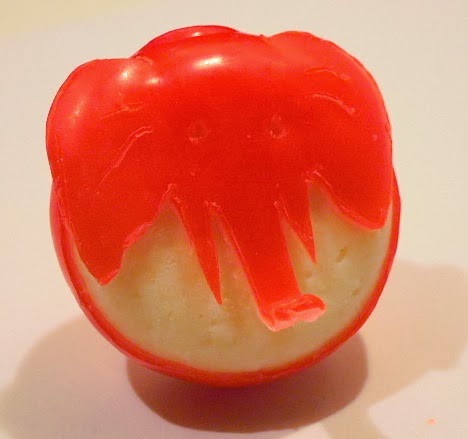


For the second elephant, I did more or less the same kind of thing, this time carving the trunk around the side of the cheese so that I could make it longer.


At the end of these two elephants, I had a tiny ball of red wax. Rather than waste it, I thought I'd try shaping a teeny elephant with my fingers.


None of these took much time at all, and I like the final results. Wrapping up the two cheeses for eating later was a bit challenging, but this was fun enough that I could be convinced to serve carved cheeses like this at a party. Or even tackle an entire scene on at full-sized Babybel.


Elephant Lore of the Day
I much prefer cheese made with goat's milk to cheese made with cow's milk, and I have a special fondness for sheep cheese. I've even had a sort of cheese made with water buffalo milk. Today was the first time, however, that I'd ever heard of anyone wanting to make elephant cheese.

French cheesemaker François Driard is known in Nepal for providing cow-milk cheeses to Kathmandu's finer restaurants and hotels. Using traditional techniques to create true French-style cheeses adapted to local conditions, Driard is considered something of an eccentric free spirit, game for just about anything cheese-related.

Now that he's perfected his Himalayan French Cheese—a Tomme de Savoie-style delicacy—Driard has been turning his attention to other animals. He rejected the idea of making goat cheese, since there are others already doing that; but then he considered elephants. "They must have so much milk," he thought.

Then he thought about it some more. There was the fact that pregnant elephants usually lactate in the jungle, meaning you'd have to go out and find them. There's also the problem of wild elephants generally not coming quietly, so you'd need domesticated elephants to keep the pregnant elephant calm.

Then there's milking them. A wild elephant is likely to be mighty annoyed at some stranger crawling underneath her to steal her milk, making this a very dangerous proposition. Even worse, elephant milk apparently goes off within an hour, so it would have to be a very fast cheese-making enterprise. For the moment, Driard has wisely decided to stick to various styles of cow cheese.

While travelling through Asia some years ago, the closest we ever got to actual cheese was some kind of canned cheese slab from Australia, and a kind of runny rennet-milk thing that we suspected might be very unhygienic. So I really like the idea of a French cheesemaker launching a European-style fromagerie in the Himalayan foothills. And if he ever does make elephant cheese, I'm ordering some.

To read more about Driard and his cheese, click here.


Phyo Phyo and her baby Kai Mook, born in 2009 at the Antwerp Zoo, Belgium.
Photo: EPA
Source: http://www.telegraph.co.uk/news/picturegalleries/picturesoftheday/5349811/
Pictures-of-the-day-19-May-2009.html?image=18


To Support Elephant Welfare
Boon Lott's Elephant Sanctuary (Thailand)
Wildlife SOS (India) 
 
The Elephant Sanctuary (Tennessee)

David Shepherd Wildlife Foundation
Big Life Foundation

Friday, 8 November 2013

Elephant No. 67: Painted Paper Lamp


Today I was in what I'm told is The Biggest IKEA in the Land, where I came across an inexpensive lamp that looked like the perfect canvas for an elephant of some sort.

I don't normally shop at IKEA—I get confused too easily and end up lost and annoyed in bathroom accessories when I want office storage—but I was at a nearby mall anyway, so I went in and found this. The price was right at five dollars; although the price of the bulb at nine dollars was not. Luckily, similar bulbs are two for a dollar at the dollar store.


The name of this little number in IKEA-speak is "Låter", in case you want one of your own. What that name means, I have no idea. Google Translate says it means "lets". Gibberish in either language, if you ask me.


It comes, like most things IKEA, flat-packed and squished.


When opened up and smoothed out as much as possible, it looks like this. Good thing elephants are wrinkly.


I thought something realistic might be interesting—albeit not in realistic colours—so I decided to draw from a photograph. This is the photograph I chose.


African bush elephant.
Source: http://true-wildlife.blogspot.ca/2010/12/african-bush-elephant.html


I thought briefly about painting multiple elephants all around the lamp, then decided I'd rather not. One elephant was enough for today, although I thought I could probably continue the greenery all the way around.

Given that this is wrinkled, I settled on thinned acrylic paint as the least likely to flake off. I also wanted it thin so that some of the light would shine through.

When I saw this lit up in the store, it occurred to me that it would have been really cool to be able to paint something on both sides, so that it I got two different images, depending on whether it was lit or unlit. You can see what I mean in a previous post on hold-to-light images. Unfortunately, I couldn't figure out how to take this apart without having to spend a lot of time reglueing it. Another time, perhaps.

I began by making a faint pencil sketch.


Next, I underpainted the elephant in various shades of purple.


I thought it might have more life if I used a bunch of other colours, so I added some blue, green, red, orange and yellow.


To finish it off, I added some outlines in a dark purple and painted the tusks white.


IKEA has a lot of paper-shaded lamps that would lend themselves readily to decoration like this. And most are reasonably priced. Despite the fact that I'm not fond of the IKEA shopping experience, it's a great place for stuff like this.

This lamp turned out a lot better than I expected, and only took me a couple of hours from start to finish. It looks much prettier in real life than in these photographs and, for five dollars, I like it enough that I'll probably end up going back to buy a couple more of these babies.


Elephant Lore of the Day
In March of this year, Australian tourists Kate and Marcus Westberg watched in amusement as a herd of elephant dithered about crossing the Chobe River from Botswana into Namibia.


Herd of elephants preparing to cross the Chobe River to Namibia.
Photo: Kate Westberg/BPNS
Source: http://www.mirror.co.uk/news/world-news/elephants-
crossing-deep-river-photo-1790934


The elephants stood together on the banks of the river, venturing into the water twice before turning back. Finally, just before dark, the herd made a final attempt.

Quickly finding themselves submerged, the adult elephants formed a protective circle around the calves, and all stuck their trunks out of the water like snorkels. Happily, all of the elephants—including the babies—reached the other side safely.


Herd of elephants snorkeling their way across the Chobe River.
Photo: Kate Westberg/BPNS
Source: http://www.mirror.co.uk/news/world-news/elephants- crossing-
deep-river-photo-1790934


To Support Elephant Welfare
Boon Lott's Elephant Sanctuary (Thailand)
Wildlife SOS (India) 
 
The Elephant Sanctuary (Tennessee)

David Shepherd Wildlife Foundation
Big Life Foundation

Thursday, 7 November 2013

Elephant No. 66: Feature Artist Carlo Allion


Il Tapetto Magico by Carlo Allion
Image courtesy of Carlo Allion

I met Carlo a couple of weeks ago at an art exposition here in Ottawa, and loved his work on sight. Not only is his technique impeccable, but his subject matter and compositions are very appealing.

In addition to long-legged elephants, horses and camels, Carlo's work features recurring cameos by his little dog, along with whimsical touches such as hot-air balloons, motor scooters and boats. His work is right up my alley, and if I'd had a bit more wall space and a bit more money, at least one of his paintings would have come home with me that day.


My Turn, Dude by Carlo Allion
Image courtesy of Carlo Allion

When talking about his work, Carlo describes a "playful state of mind. I just do it and say, 'Why not have very long legs?' It was a natural evolution. I was painting a figurative Giacometti-inspired style of people and then I started incorporating animals, and it was a natural thing to make the animals fit to scale.  . . . I think you can read a lot of metaphors in it—like how fragile nature is, etc. To me, it is an abstract look of what I see. I don't want to necessarily represent things as they should be."


Colby the Explorer by Carlo Allion
Image courtesy of Carlo Allion
 
His current work combines the sculptural forms of his animal and human figures with finely detailed painting and a high-gloss resin coating that makes everything glow. His attenuated figures often stand in open or blasted landscapes, lending them a lonely look that is often alleviated by a playful feature such as a dog on an airborne scooter or a man floating by in a flying rowboat. One of my favourite of his non-elephant paintings features a goggled aviator in a Leonardo da Vinci-inspired flying machine.


Concerto d'amore #1 by Carlo Allion
Image courtesy of Carlo Allion

"Art is quite personal," says Carlo. "For many artists, creating becomes part of your life. It is like oxygen—you need art to breathe. If you don't create art, you are not a happy person. It doesn't matter how difficult it is; if you really have it in you, you'll find a way and keep creating."


Take Me for a Stroll by Carlo Allion
Image courtesy of Carlo Allion

Carlo is also an elephant-lover like many of us, and often sponsors an orphaned elephant at the David Sheldrick Wildlife Trust when he sells a painting. Gotta like that.

To see more of Carlo's wonderful work, visit his website here.


Lacivus Barrus by Carlo Allion
Image courtesy of Carlo Allion


Elephant Lore of the Day
Because so much of Carlo's work features his little Yorkshire terrier, today's elephant lore is about the friendship between a South Carolina elephant and a Labrador retriever.

Bubbles, a 30-year-old female African elephant, came to the United States about 20 years ago. Orphaned when her parents were killed for their tusks, Bubbles was one of the lucky ones. While many of her fellow orphans were euthanized due to a perceived lack of available care in Africa back then, Bubbles was flown to a new home in South Carolina.

Apparently Bella and Bubbles formed a strong bond right away, and now play together most of the day. Bella loves to chase tennis balls, so Bubbles has learned to pick up the ball in her trunk, tossing it for her furry friend. And when Bubbles wades into the water, ball in trunk, Bella will climb onto the elephant's back in an attempt to get at her favourite toy.


Bubbles then tosses the ball for Bella, and Bella jumps off to retrieve it. Swimming away from Bubbles with her prize, Bella seems to enjoy the fact that the elephant is in hot pursuit.


To read more, click here.

All photographs ©Barry Bland
Source: http://www.dailymail.co.uk/news/article-2421505/Just-point-truck-threw-ball--
Charming-pictures-orphaned-elephant-playing-catch-labrador.html


To Support Elephant Welfare
Boon Lott's Elephant Sanctuary (Thailand)
Wildlife SOS (India) 
 
The Elephant Sanctuary (Tennessee)

David Shepherd Wildlife Foundation
Big Life Foundation

Wednesday, 6 November 2013

Elephant No. 65: Clothespin-Activated Mouth


I was at a yarn-spinning session yesterday, and one of the group members brought some of her fibre art from a recent show. Lynda had some lovely little kits for a make-your-own snowflake garland, and they included tiny wooden clothespins. When I happened to be near a dollar store a couple of hours later, I saw some similar clothespins, so I decided to buy a couple of packages to make an elephant.

I remembered vaguely that clothespins are among the hardest things to attach to one another if you plan to make anything recognizable, but I thought I'd give it a go anyway. I suspected I'd be cursing and flinging little clothespins all over the place before I was done, but nothing ventured, nothing gained.

These were the clothespins I bought. As you can see, they're very small.


I began by clipping some clothespins together to make the head and ear. This took me half an hour, because the clothespins couldn't firmly attach to one another, and kept sproinging apart, often disintegrating in mid-air.


I tried making a body next, with the same result: clothespin shrapnel everywhere. And forget about actually attaching the body to the head.


I decided to try again, this time working on body and head at the same time. Same thing: everything sproinged apart, or twisted and fell off—usually behind the furniture.

I decided to regroup. I remembered seeing another idea for clothespins, in which the opening and closing of the clothespin serves as the opening and closing of a mouth. Obviously this would work best with something wide-mouthed like an alligator or a frog, but I thought I could make it work for an elephant.

I thought briefly about using a large clothespin, then decided I'd work with one of the little ones. They might as well make themselves useful after being so, well, useless for the previous hour or more.

Placing a clothespin on a piece of artist-quality bristol board, I drew lightly around it with a pencil. This was mostly to guide me when it came to size. I then sketched out an elephant shape, using the centre indent of the clothespin as the centre of the mouth. I was originally going to make it double-sided, then thought that it might be easier to manipulate the mouth if it were one-sided. That way, I could also hide the clothespin completely inside the shape.


Because I couldn't really bisect the entire elephant to make the mouth work, I opted to separate just the jaw from the body of the elephant.

I outlined everything with a fine permanent marker, then heat-set it with a hairdryer. As you can see, the final mouth is about half again as big as what would show when the whole thing was assembled.


I coloured everything in with watercolour pencils, then activated the pigment with water to make it look painted.


And finally, I glued the two parts of the elephant—jaw and main body—to the clothespin with double-sided tape. I stuck the mouth on first, then marked its placement on the reverse side of the main elephant.


And here it is in action. Sorry about the quality of the video.


I don't think I'll ever try clipping clothespins to one another again, but as a fallback, I kind of like this little guy. I thought he would be a lot smaller when I started, but for a small mouth like this, the mini clothespin actually worked quite well.


Elephant Lore of the Day
Because I ended up with less time than I had anticipated today, I decided to bring back one of my favourite elephants from the original Elephant a Day blog.

In 1936, a man named Richard Halliburton decided to retrace Hannibal's exploits by cross the Alps on the back of an Asian elephant named Dally—short for Elysabethe Dalrymple.

The trouble started almost as soon as Dally left her home at the Paris Zoo. Although the first bit of Halliburton's walk through the Bois de Boulogne went well, Dally balked as soon as she encountered the Porte Maillot and traffic. A taxi driver, approaching from behind, honked his horn within a couple of feet of Dally's tail. Unable to take the stress, Dally leapt into the air, then took off, trumpeting in terror, charging blindly down the Avenue de la Grande Armée at speed. Halliburton was flung off first, followed by his baggage, and finally her hollering mahout, Harel.

Chasing her did no good, serving only to panic Dally even more. She banged into parked cars, scattered pedestrians and cyclists, and caused a great deal of screaming. She was only stopped by a solid mass of traffic that had halted at a light. Squealing miserably in the midst of a tangle of cars, Dally was held by the shocked drivers until her keepers could come and get her.

Surprisingly, Halliburton was not deterred by this setback. Dally went back to the Paris Zoo, where she was given several months of traffic training. When Halliburton came back, Dally was ready for the adventure. Travelling by freight train through France, Halliburton, Dally, Harel and a truck carrying supplies and feed for Dally alighted in Martigny, Switzerland. Darkness had set in, but the sight of an elephant walking the streets of the town was still enough to send many people running away in fear. Halliburton reckoned that it might have been the first time anyone had seen an elephant in Martigny in more than two millennia.

After several days' travel, then arrived at St. Bernard's Pass and headed down into Italy. Dally perked up as they descended, actually playing a giant harmonica, which was apparently her favourite thing in the whole world. Everything seemed relatively idyllic until the party ran smack into mountain manoeuvres being conducted by the Italian Army.

Forty thousand soldiers popped up all around the little party. As Halliburton put it, "The slopes and woods suddenly swarmed with them; they filled the road, they and their military trucks, and their artillery, and their tanks and cavalry." Apparently the Italians were as surprised to see Halliburton as he was to see them. They seem to have been particularly astonished by the sight of an elephant playing a harmonica. Cheering Dally on with cries of "L'elefantessa! L'elefantessa!" soldiers came running from all over, eventually allowing the group to pass.

Halliburton had gone about half a mile down the road when disaster struck again. Although Dally had been desensitized to traffic, she had not been desensitized to the sound of gunfire. The military was on manoeuvres, after all, and a gun emplacement suddenly began firing real shells not 200 metres from where Dally was walking. The noise was too much for her, and she reared up on her hind legs, trumpeted frantically, turned around and dashed back the way she'd come in an even more uncontrollable panic than in Paris. Halliburton again hit the ground, Dally's lead rope was ripped from Harel's hands, and she charged into the midst of the troops—which obligingly scattered.

Dally was eventually brought under control, but the adventure was over. Dally, Haliburton and Harel headed back to Paris by train, where Dally was returned to the Paris Zoo. As a parting gift, Halliburton presented her with a new harmonica.

For part of Halliburton's firsthand account and a link to more photographs, click here.


Dally, Haliburton, and Dally's mahout Harel walking through Italy, 1936.
From the entertaining Beachcomber's Bizarre History Blog at
http://www.strangehistory.net/2010/07/24/an-elephant-invades-italy-in-1936/


To Support Elephant Welfare
Boon Lott's Elephant Sanctuary (Thailand)
Wildlife SOS (India) 
 
The Elephant Sanctuary (Tennessee)

David Shepherd Wildlife Foundation
Big Life Foundation