Saturday, 5 October 2013

Elephant No. 33: Apple Pie


Apple season is in full swing around here, so today I thought I'd make an apple pie. I rarely make pie—and don't even like apple pie myself—but Terrence loves it, so I guess today is my nice day.

My first step was a trip to the local farmer's market for a basket of apples. I had no idea which apples would be best for pies, but I guessed it might not be the crunchy kind I like to eat. The apple-seller suggested Lobo, so that's what I bought.


Although I'm actually pretty good at pie crust, I didn't feel like dealing with the huge mess I somehow manage whenever I make it. Frozen pie shells happened to be on sale, so I decided to cheat and buy pie crust. If you prefer to make your own pie crust, here's my no-fail recipe for two 9-inch (22.9 cm) crusts, used in an early post from the original Elephant a Day Blog. The original post also included step-by-step instructions and photographs.

Pie Crust
2-1/2 cups (625 ml) all-purpose flour
1/2 teaspoon (2 ml) salt
1/2 cup (125 ml) cold butter, cubed
1/2 cup (125 ml) cold lard, cubed
1/4 cup (60 ml) ice water (approx.)
3 tablespoons (45 ml) sour cream

These were the pie shells I bought. I prefer this particular brand, because I find that lard makes a nice flaky pie crust. My mother, however, always uses vegetable shortening, and her pie crust is mighty good as well, so use whatever you prefer.


I left the pie shells to thaw on the countertop while I made the filling, using the recipe below.

Filling
7–8 cups (1.75–2 litres) peeled, sliced apples—about 6 large apples, or 2.25 lbs/1 kg
2 tbsp (25 ml) lemon juice
1/2 cup (125 ml) granulated or brown sugar—I used 1/4 cup of each
3 tbsp (45 ml) all-purpose flour
1–1.5 tsp (4–6 ml) cinnamon

I tossed all the filling ingredients together and set them aside.


I transferred one of the shells to a proper pie plate, since I don't like the flimsy aluminum plates frozen pie shells come in. The shell was a bit smaller than my pie plate, so I had to stretch it a bit. When I'd stretched it as much as I could, I poured in the filling.


I added the top crust, then crimped the edges. The edges weren't near as wide as they should have been, so I pinched and crimped them firmly, squeezing a bit into the body of the pie as well.


Pies need steam vents in the top, so I cut vents in the shape of an elephant standing in tall grass, flinging water over its back.


To make it look pretty, I brushed the top with the yolk of one egg, and sprinkled it with coarse white sugar—the sparkly kind you use to decorate cookies.


I baked the pie on the oven's lower rack at 425˚F/220˚C for 15 minutes, then reduced the heat to 350°F/180°C, moved it up to the middle rack, and cooked it for another 30-40 minutes. The pie is done when the top is golden and the filling bubbles a bit through the vents. To be sure it's done, poke gently through one of the vents. If the apples are soft, it's done.

I was a bit disappointed in the way the elephant turned out. It didn't deform or anything, but I had expected the vents to widen, and most of them didn't. It may have had something to do with the juices escaping out of a small break in the side of the crust. The egg-yolk wash had also sealed up some of the smaller cuts. I gently teased a few of the cuts open, then left it to cool. It should cool for an hour or so on a rack—less if you prefer to serve it warm.


The recipe should serve 8, but in my house it serves only one.


Elephant Lore of the Day
Although I'd never heard of it before, apparently there is a fruit called the elephant apple (Feronia elephantum/Limonia acidissima). Also known as monkey fruit and wood apple in English, it is native to South and Southeast Asia.

The tree grows about 30 feet (9 metres) tall and has rough, spiny bark. The leaves have a citrus scent when crushed, and the fruit is essentially a large berry measuring 2–3.5 inches (5–9 cm) in diameter. Its rind is so thick and hard that it is very difficult to crack, and is often used to make small bowls, ashtrays and utensils.


Interior of elephant apple purchased in Pune, India.
Source: http://en.wikipedia.org/wiki/File:Wood-apple_dec2007.jpg

The interior looks mighty unappetizing to me, but it's supposed to be quite tasty. It's eaten plain, made into jams and chutneys, mixed with yogurt, and pureed to make a refreshing drink. The leaves of the tree are also used as a salad green in Thailand. The fruit in particular is loaded with vitamins, including beta-carotene, several B vitamins and vitamin C.

In addition to being edible, the fruit pulp can also be used to make a soapy household cleaner. Unripened fruit is distilled to produce a glue for use in jewellery, cement and art. The rind exudes an oil used in a popular hair fragrance, as well as a fabric dye. And every other part of the tree from bark to leaves to wood is used for purposes ranging from woodworking to traditional medicines.


Leaves and fruit of elephant apple, Chitoor, Andhra Pradesh, India, 2008.
Photo: J.M. Garg
Source: http://en.wikipedia.org/wiki/File:Limonia_acidissima_
syn_Limonia_elephantum_or_Fernonia_limonia_%28wood-apple%29_in_
Talakona_forest,_AP_W_IMG_8333.jpg

Because it's such a useful tree, elephant apple is often planted as a hedge, providing fruit, foliage and shade. And yes, elephants love it. In southern India, the leaves and fruit of the elephant apple have long been a favourite food of captive elephants, and its branches are used to scrub the elephants at bathtime.


Festival elephant at bathtime, Tripunithera, India. The mahout is adding a
bit of laundry soap to get the elephant nice and clean.
Photo: Vinod Karimatt
Source: http://vinodkarimatt.blogspot.ca/


To Support Elephant Welfare
Boon Lott's Elephant Sanctuary (Thailand)
Wildlife SOS (India) 
 
The Elephant Sanctuary (Tennessee)

David Shepherd Wildlife Foundation


Friday, 4 October 2013

Elephant No. 32: Spelter Night Light


I came across this wonderful little lamp by chance yesterday, while poking around in nearby Almonte with my friend Jennifer. Tucked away on the top shelf of the funky Tin Barn Market, it caught my eye as I was leaving. As I reached for it, three other women in the shop also saw it, one of whom looked a little put out that I'd seen it first. I felt a little guilty as I carted it off—although not guilty enough to give it up.

Its materials and design suggest to me that that it might be from the 1940s or 1950s, although it's always hard to tell with a design like this. I could see that it was made of spelter (a zinc alloy often used for decorative items), thinly plated to resemble brass or copper. It measures about 10 x 6 x 3 inches (25 x 15.25 x 7.5 cm), so it's bigger than a conventional nightlight, but smaller than a lamp.


The top appears to be made with copper-plated steel, and the inset glass panels are a lovely pebbled amber-orange glass. I found one on eBay that was almost identical, but with a finial that mine lacks, and frosted white glass panels. Mine also looks like it was dropped at some point, since the tip of the trunk was broken off, and part of the howdah on top was dented. The spelter is also showing signs of age with small cracks in the feet and head.


It needed a bit of cleaning up when I got it home, but it works, and I like it very much. Even better was the price. The one on eBay is listed at $500.00 US. I got mine for $65.00 CDN.
 
By the way, if you have a piece of plated spelter like this to clean, stick to gentle options. Soft cloths, a mild grease-cutting soap, rubbing alcohol, and minimal water are your best bets. Avoid metal cleaners and too much buffing, or you may remove the plating and end up with something that's more white metal than pseudo-brass or pseudo-bronze. If it's particularly gunky, like the howdah was on mine, a citrus-based cleaner like Citrasolv works nicely—just make sure to remove and neutralize the Citrasolv with alcohol or soap and water.

If anyone out there has seen one of of these, or knows more about it, I'd love to hear from you. And if you have one of your own and can send a photograph, that would be fantastic.

No idea where to put this little guy, but when something this fun comes along, who cares?


Elephant Lore the Day
In June of this year, a three-man team from Kenya arrived in Livingstone, Zambia to help control elephants with flashing lights.

Kenyan wildlife experts discovered that, if small flashing lights were attached to trees or poles about 25 metres (82 feet) apart, elephants wouldn't venture beyond that point. And perhaps none too soon. In some places, elephants were venturing onto farmland so often that people had given up farming entirely, and resentment of elephants was growing.

The system actually originates in the United States, where lights have been used for years to keep wildlife from entering towns. The solar-powered lights are currently being employed in regions across East Africa, nailed to trees and electricity poles. 


African elephant.
Source: http://www.gorongosa.org/our-story/conservation/preventing-
human-elephant-conflict


To Support Elephant Welfare
Boon Lott's Elephant Sanctuary (Thailand)
Wildlife SOS (India) 
 
The Elephant Sanctuary (Tennessee)

David Shepherd Wildlife Foundation

Thursday, 3 October 2013

Elephant No. 31: Bookmarks


I never seem to have enough bookmarks for all the books I'm reading at any given time, so today I decided to make some.

I started by cutting four pieces of bristol board measuring approximately 2.25 x 6.5 inches (5.7 x 16.5 cm). I sketched a different elephant design on each, not being particularly realistic, nor particularly stylized.


I used a permanent pigment liner pen to outline everything, then heat set the ink with a hairdryer.


I coloured them in with watercolour pencils: Derwent Graphitint pencils for the grey, and Derwent Inktense for everything else. I shaded to a certain extent as I went, but I intended to wet all of the colours, so I wasn't terribly precise with the pencils. For the coloured backgrounds, I scribbled with the flat of the various Inktense colours and pressed hard to make sure I had lots of colour to work with.


Once I'd coloured everything in, I painted over the elephants with a moderately wet paintbrush. For the backgrounds, I used a fairly wet paintbrush to release the saturated Inktense colours.


To finish them off, I punched a hole in the top of each bookmark, and added a bit of ribbon using scraps left over from various projects.


I liked making these a lot more than I thought I would, and I'm pretty happy with the final result. In fact, if I'd known how quick and easy they'd be, I'd have said adiós long ago to all the bits of junk mail, tags and other scraps of paper I use to mark my place.


Elephant Lore of the Day

At Angkor Thom in Cambodia, King Jayavarman VII ordered the design and construction of a terrace supported by elephants. Built of stone, wood and thatch, the 350-metre-long Terrace of the Elephants was essentially a giant reviewing stand, used by the king to view his returning army—which no doubt included elephants.

The Terrace was also used for public ceremonies, and as the king's audience hall. Although in ruins today, it originally had five sections extending towards a central square. The retaining wall is decorated with life-sized lions, bookended by two parades of elephants with their Khmer mahouts.


A section of the Terrace of the Elephants, Angkor Thom,
Cambodia.
Source: http://en.wikipedia.org/wiki/File:Terrace-of-the-elephants.jpg

Ruins of the Terrace of the Elephants, Angkor Thom, Cambodia.
Source: http://www.tourismcambodia.com/attractions/angkor/terrace-of-elephants.htm


To Support Elephant Welfare
Boon Lott's Elephant Sanctuary (Thailand)
Wildlife SOS (India) 
 
The Elephant Sanctuary (Tennessee)

David Shepherd Wildlife Foundation


Wednesday, 2 October 2013

Elephant No. 30: Apache Tears


For today's elephant, I didn't want to draw, paint, glue or otherwise make anything. But I didn't mind the idea of arranging something. Today I decided to arrange rocks into an elephant shape.

I love rocks. As a kid, one of my favourite things to do after it rained was walk along the curbs, picking out the prettiest rocks. Rock always look nicest when wet, in my opinion. To this day, I still pick up a few rocks wherever I travel.

Some years ago, I inherited a rock collection from an elderly man I'd known since childhood. He often used to give me rocks and pebbles when I was small, trying to impress their names upon my unfocused little brain. One of the most plentiful rocks in his collection was apache tears.


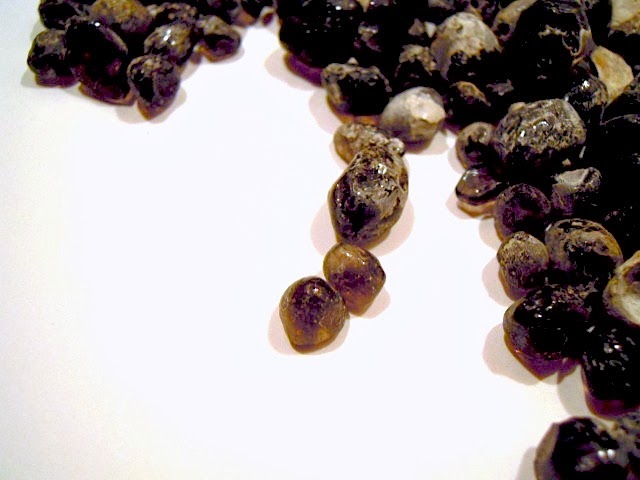
Apache tears are small rounded pieces of obsidian—a black volcanic glass. They appear opaque until you hold them up to the light, when they become surprisingly translucent. Usually black or grey, they also come in shades of brown, and are often embedded in a fragile later of white perlite.

The story of apache tears comes from a well-known legend. In the 1870s, about 75 Apache warriors fought the U.S. Cavalry on a mountain overlooking today's Superior, Arizona. Instead of accepting defeat, the outnumbered warriors rode their horses off a cliff, preferring suicide to death at the hands of their enemies. When the Apache women learned of the fate of their men, they wept, their tears turning to stone when they hit the ground.

American singer-songwriter Johnny Cash wrote a 1964 song about the incident called "Apache Tears", which you can hear here.

I have a very large quantity of apache tears, so I didn't think this would be difficult. I began by simply dumping a quantity of the stones onto a sheet of white bristol board. As you can see, some of the pieces are quite large. I removed these and stuck to small and medium stones.


I shaped a baby elephant first, simply pushing things around with the side of my hand.


That took all of five minutes, so I tried an African elephant's head next. this was much harder for some reason. But it still only took about fifteen minutes.


I didn't mind this activity at all. No muss, no fuss, and at the end it all goes back into the bin from whence it came.


Elephant Lore of the Day
In an article earlier this year, wildlife filmmaker James Honeyborne described an interesting encounter he had with elephants in Botswana's Okavango Delta.

Unexpectedly caught a little too close to elephants for comfort, Honeyborne and two other crew members crouched down, hoping not to be trampled. Although elephants often become aggressive as a result of previous run-ins with hunters and poachers, in this case the older elephants seemed more interested in explaining humans to their calves. As the three men did their best to appear non-threatening, three mother elephants brought over their babies.

According to Honeyborne, "It appeared to be for their education—as if the mums were saying, 'Come here, kids, and look at this!'" The babies came within five or six metres (15 to 20 feet) of the men, looking around and wiggling their trunks as if trying to figure out what they were supposed to be looking at. Finally their eyes locked onto the camera crew.

To Honeyborne, it then appeared as though the mothers and calves were discussing the strange creatures huddled on the ground. For a full ten minutes, the elephants rumbled to one another, before the matriarch finally led the herd away. Read more of his story here.


African elephant and baby at water hole.
Photo: Nick Dale
Source: http://nickdale.me/photography/mother-and-baby-elephant-at-
the-water-hole-2/


To Support Elephant Welfare
Boon Lott's Elephant Sanctuary (Thailand)
Wildlife SOS (India) 
 
The Elephant Sanctuary (Tennessee)

David Shepherd Wildlife Foundation

Tuesday, 1 October 2013

Elephant No. 29: Upcycled Pop Bottle


I've seen this technique several times, mostly to make upcycled flowers for jewellery. To get a general idea of how it works, click here to see the tutorial I used for inspiration.

I couldn't find a tutorial showing how to make elephants—or any other kind of animal—so this was going to be an experiment. My main fear was that I'd accidentally set something on fire, given the combination of plastic, an open flame, and my general clumsiness.

I began by cutting apart a 2-litre soda bottle. There are tutorials on making flowers using every part of the bottle, from neck to base, but I figured I'd need only the central area.


I sketched an elephant shape, with separate ear, onto the plastic with a permanent marker, then cut out both parts. Because I didn't want blue on my elephant, I cleaned off the marker with alcohol. I also washed the piece carefully, so that it wouldn't catch fire or something when I put it into the flame.


Holding the main piece of plastic over a tealight flame with tweezers, I waited for it to soften enough that I could shape it. It actually shapes itself before you can really do much. It also shrinks a bit.


Because it has a mind of its own, I started holding various areas over the flame, catching them as soon as they softened and doing what I could to shape them before the plastic rehardened. I also noticed that I didn't need to hold the plastic all that close to the flame for it to begin softening.


I ended up with something that was curved in on itself, so I softened the centre of the elephant's body, quickly pressing it onto my work surface to flatten the whole thing a bit.

The tail and trunk also needed a bit of attention, so I softened them each several times, twisting and bending them with the tweezers.


Once I had finished the main body of the elephant, I worked on the ear. This mostly consisted of touching the edges to the flame, allowing them to shrink and ripple a little on their own. To finish the ear, I softened the middle of it, and flattened it slightly on my work surface.


I attached the ear to the body with super glue. Some sources suggest that you can heat both parts to stick them together, but I'm not that adept with flames and I didn't want to risk ruining the pieces I'd so carefully shaped.


Many tutorials will suggest colouring the final piece with permanent markers, but I liked this piece as it was. I'm not sure what I'll do with it, as it lies flat rather than standing up on its own. It is, however, much thicker and harder than the original material, and has a sort of glassy look that's rather appealing.

This was quick and easy and—big bonus—I didn't burn or singe my fingers. I liked it enough that I already have a larger project in mind for this technique, if I ever find enough time to carry it out.


Elephant Lore of the Day
Although fully grown elephants are almost impervious to solitary predators, they can sometimes be taken down by lions hunting in groups. It takes seven lionesses to kill an elephant, but only two male lions—and young elephants can be killed by a single lion. In one case in Botswana, a solitary male lion ran full tilt into the side of a six-year-old male elephant, knocking it over before killing it.

Interestingly, as lions have gotten better at hunting elephants, elephants have developed ways of defending themselves. In a notable experiment in 2001, Karen McComb of the University of Sussex played the roars of male lions to a herd of elephants. The older matriarchs—who are usually the leaders of elephant herds—hardly reacted at all to the sound of  single lion roar. When presented with the roars of multiple lions, however, they quickly ushered the herd into a defensive formation.

When hunting elephants, lions almost always attack from behind. They circle a baby or a straggler, then jump onto its back—away from the powerful trunk—and drag the hapless elephant to the ground. Since lions never go for a frontal assault, elephants form circles with their trunks and tusks facing outwards, and the weakest members of the herd in the centre.

The video below shows elephants reacting to the recorded sounds of multiple lions roaring. To read more from the original article, click here.


To Support Elephant Welfare
Boon Lott's Elephant Sanctuary (Thailand)
Wildlife SOS (India) 
 
The Elephant Sanctuary (Tennessee)

David Shepherd Wildlife Foundation