
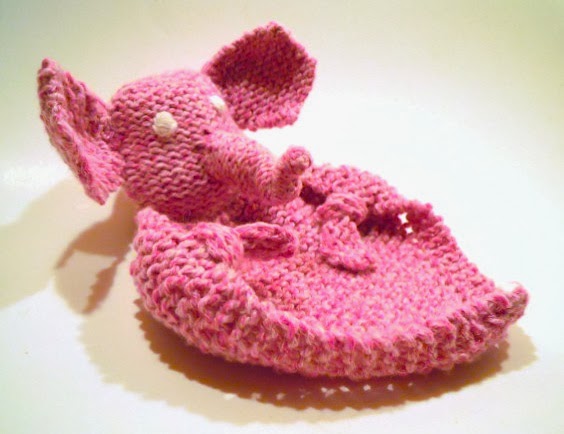
With Christmas coming, I've been looking around for things I could make fairly quickly. I came across a cute little knitted rabbit toy/blankie in the book 101 Designer One-Skein Wonders, so I decided to see if I could turn it into an elephant.
I won't post the pattern here, as the design is copyrighted, but if you're interested in the elephant adaptations I made, just send me a note.
This is the original "Blanket Buddy", designed by Mary Anne Thompson. It looks large in the photo, but the final knitted version is only about a foot square.

Using a chunky cotton-wool yarn, I began by knitting the body and arms. For those of you who speak knitting, it's a very simple garter stitch pattern with yarn-overs to create the holes, and knitted increases on each side to make the widening triangular shape. The arms are made with a series of cast-on stitches.


The head comes next, with the front and back knitted together, eventually forming a pouch. This was something I'd never heard of doing before, but it worked.


At this point, the original pattern tells you how to make the ears, knitting them right into the head before stuffing. The pattern suggests that you can adapt this to make different ears for different animals. Well, maybe if you were doing a cat or a bear instead of a rabbit. Not so much for an elephant. I tried to adapt the knitted-in ears, but I ended up with long floppy I-don't-know-what ears the first two times, and mouse ears the third time. I decided to regroup.
I began by stuffing the head lightly, remembering that it should be on the soft side for a baby. I then stitched the top of the head closed.

Next, I knitted a couple of ears by casting on six stitches, increasing gradually out to 14, then decreasing gradually back down to eight.
For the trunk—again for those of you who speak knitting—I cast on 12 stitches on double-pointed needles, knitting in the round for about 10 rows. I decreased gradually to six stitches, at which point I switched to an i-cord technique. Before attaching the trunk to the head, I stuffed it gently.

I attached the ears to the head first, as I thought this would make it easier to figure out where to put the trunk. After I'd attached the trunk, I added a few stitches to give it some shape.


To finish this, I stitched on some eyes with white yarn, and tied the arms in knots. And, because this is for a baby and will probably get a lot of wear and tear, everything is double-stitched.

When I was trying to figure out the ears, I almost turned this back into a rabbit, but I'm glad I persisted. The final is pretty cute in real life—and it's soft and cuddly, as any self-respecting blankie/toy should be.
Elephant Lore of the Day
I first told this story in the original Elephant a Day blog, but since it's about blankies for orphaned baby elephants, I thought it fit perfectly with today's post.At the deservedly renowned David Sheldrick Wildlife Trust in Kenya, orphaned baby elephants are coaxed to feed by surrogate mother elephants—in the form of rough, grey blankets hanging from trees. Although to us these blankets look nothing like mother elephants, they actually serve an important purpose.
Baby elephants usually arrive at the orphanage following traumatic rescue from life-and-death situations. Distraught and frightened, they often succumb to pneumonia and gastric infections caused by stress. They also frequently refuse to eat. This presents a particular challenge for the people trying to save them.
It was discovered however, that if a baby elephant feels something similar to the texture of its mother's stomach when it reaches up, it can be coaxed to feed. Encountering large expanses of grey hanging throughout the bush, baby elephants will walk over to the blankets, touching them with the tips of their trunks in curiosity. Reassured by the texture, they will snuggle closer and run their trunks over the surface, just as they would do with their mothers in the wild. It then becomes easier to feed them from a bottle.
 |
| Baby elephant and grey blanket, David Sheldrick Wildlife Trust, Nairobi, Kenya. Photo: Worldwide Features.com Source: http://www.dailymail.co.uk/news/article-2115392/Baby-elephants-comfort- blanket-How-huge-grey-rug-doubles-surrogate-mother-orphan-feeding-time.html |
The babies remain dependent on the blankets for the first few months, then take the bottle without the blanket, then become tactile with the rest of the herd. When the elephants are between twelve and eighteen months old, they are moved to rehabilitation centres in Kenya's East Tsavo National Park, and are eventually released back into the wild.
 |
| Keeper feeding orphaned baby elephant at David Sheldrick Wildlife Trust. Photo: Worldwide Features.com Source: http://www.dailymail.co.uk/news/article-2115392/Baby-elephants-comfort- blanket-How-huge-grey-rug-doubles-surrogate-mother-orphan-feeding-time.html |
To Support Elephant Welfare


