Showing posts with label elephant blog. Show all posts

Saturday, 13 June 2015

Elephant No. 133: From the Archives: Playing Card


It's the weekend, and I'm taking it easy, so here is one of the early postings from the original Elephant a Day blog. Enjoy!

Today I felt like doing something quiet and sedentary, so I decided to make a traditional playing card.

Playing cards were invented in Ancient China around the ninth century A.D. By the eleventh century, they could be found throughout Asia, likely transported along the Silk Road. Ancient Chinese "money cards" had four suits: coins, strings of coins, myriads (10,000) of coins, and tens of myriads. Some scholars believe that the first playing cards in China might have been a form of actual currency.

Playing cards came to Europe in the late fourteenth century, probably from Mameluke Egypt. The Egyptian deck had 52 cards, with four suits: polo sticks, coins, swords and cups. Each suit had ten number cards, featuring "pips" or suit symbols. There were also three "court" cards: King, Deputy King and Under-Deputy.

The Egyptian deck may have influenced the design of East Indian cards, although some suggest that it might have been the other way around. Early Indian cards are quite distinctive: they are circular, intricately hand-painted, and have anywhere from eight to thirty-two suits.


Ganjifa cards, with ten suits showing the ten avatars of Vishnu
Nineteenth century
Los Angeles County Museum of Art
Source: http://en.wikipedia.org/wiki/File:Ganjifa1.jpg


By the late fourteenth century, the use of playing cards had spread across Europe. The earliest cards were individually handmade and expensive; however, by the fifteenth century, decks printed from woodcuts had begun to appear. Most early woodcuts were coloured after printing, either by hand or using a stencil. A deck usually had four suits, although five suits were also common. In Germany, the suits were hearts, bells, leaves and acorns. Italian and Spanish cards used swords, wands, cups and coins.

The four suits most commonly used today—hearts, spades, diamonds and clubs—originated in France around 1480. The club (trèfle, or clover, in French) was likely derived from the acorn on German cards; the spade, from the German leaf. Europeans also changed the court cards to represent European royalty: originally with King, Knight and Knave, and later with King, Queen and Jack.

At first, the King was always the highest card. As time went on, the Ace took on greater significance, eventually becoming the card with the greatest value. Some have suggested that this concept was given a boost during the French Revolution, when the peasantry wrested power from the monarchy. 

Court cards with mirror images were invented in the late eighteenth century. This was so that players would not be tempted to turn the court cards right side up, which might hint at the cards they held. The use of the manufacturer's logo on the ace of spades began during the reign of James I of England (1556–1625), who passed a law requiring an insignia to show that duty had been paid on the cards. Duty was paid on playing cards in the United Kingdom until 1960.

The most common size for playing cards is 2-1/2 x 3-1/2 inches (poker size) or 2-1/4 x 3-1/2 inches (bridge size). Traditionally, the Jack of Spades, Jack of Hearts, and King of Diamonds are drawn in profile—these are the "one-eyed" cards. The rest of the court cards are depicted full-face. The King of Hearts is the only King with no mustache, and is also typically shown with a sword his head, making him look as though he's stabbing himself.

For today's elephant, I decided to make a standard poker-sized card, based on the King of Hearts from the Bicycle Playing Card deck.


To start, I traced around one of the Bicycle cards. Expecting that I would screw up at least once, I made four blanks, all from inexpensive bristol board.


In order to create a mirror image of the Elephant King of Hearts, I drew a line across the middle of the card, then sketched in the elephant. Although I used the general idea of the King of Hearts from the Bicycle deck, I decided not to have the elephant stabbing himself in the head with a sword. Although the King of Hearts may traditionally be nicknamed the "suicide king", I didn't want a suicide elephant.


Drawing a mirror image freehand is actually more difficult than you'd think. Short of making a grid (which I knew I would greatly dislike), there's no easy way of doing this. What worked best for me was to draw a bit of the design on one half, then flip it around and draw as close to the same thing as possible on the other half. I guess I was hoping my fingers would have some sort of memory of what they'd just done. It wasn't always as precise as I would have liked, but it came out close enough.

I wanted something on the back as well, but the Bicycle Poker Card design is beyond what I can do on such a small surface with a limited amount of time. I did another mirror design with a few nods to the idea behind the Bicycle design, but it's nowhere near as detailed as the card that inspired it.


I had originally planned to use drafting pens for this. I had blue, red and black drafting ink on hand, and planned to fill the yellow in with coloured pencil afterwards. Unfortunately, the blue ink was old and not very cooperative, so after a few attempts with ink, I went with coloured pencil instead.

I wanted to stick more or less with the same colours as are on the Bicycle cards, so that's the colour palette I used.


I didn't get quite the crisp result I expected, but I certainly learned a lot about drawing mirror images. And old ink. And the propensity of coloured pencil to smudge. And how you can't erase lead pencil after you've put coloured pencil in the same vicinity.

It was definitely an interesting exercise. Just don't expect a pack of Elephant Poker Cards anytime soon.


Elephant Lore of the Day
In the French playing cards on which most modern decks are based, the King of Hearts is said to depict Charlemagne, Emperor of the Franks.

In A.D. 802, Charlemagne received an Asian elephant named Abul-Abbas from the Caliph of Baghdad. Abul-Abbas was brought from Baghdad by a man called Isaac, who had been sent to the Caliph on Charlemagne's orders. Following the deaths of the two other emissaries sent to Baghdad with him, Isaac returned alone with the elephant. The journey took many months: first by land along the Egyptian coast and across modern Algeria and Tunisia, then by sea from Tunisia to Europe.

Abul-Abbas was a big hit in his new home, and was exhibited many times at court. He was eventually housed in Augsburg, in today's southern Bavaria. Sadly, Abul-Abbas died of pneumonia when he was in his forties, likely from swimming in the Rhine. His bones were preserved at Lippenham, Denmark until the eighteenth century.

Some say that Abul-Abbas was an albino elephant. Legend also suggests that he was used as a war elephant in A.D. 804, when the Franks were attacked by the Danes. Mobilizing his troops, Charlemagne is said to have asked that Abul-Abbas be sent to him, so that the elephant could take part in the battle.


To Support Elephant Welfare

Thursday, 11 June 2015

Elephant No. 131: From the Archives—Altoids Tin Diorama


Over the past several years, people have been using Altoids tins to make lots of interesting things, from tiny amplifiers to little shrines to homes for itty-bitty animals. So today, I thought I'd try making something using an Altoids tin.

Altoids are strong breath mints that were first produced in England in the 1780s. Billed as the "Original Celebrated Curiously Strong Mints", Altoids are characterized by a high proportion of peppermint oil.

Interestingly, Altoids are harder to find in Britain than in the other countries to which they are exported. They have never been heavily marketed in Britain; however, in the United States they are so popular that the brand's owner moved Altoids production to Chattanooga, Tennesee, to be nearer the primary market.

In addition to the traditional mints—currently available in seven breath-freshening flavours—Altoids makes sour hard candies in round tins. Other items such as chewing gum, chocolate-dipped mints, and breath strips have also been marketed over the years, but have since been discontinued.


A selection of Altoid tins.
Source: http://en.wikipedia.org/wiki/File:Altoidstins1b.jpg


In addition to the mints, many people buy Altoids simply to get the handy little tins. Some people use them as simple containers for household items such as paper clips, little sewing kits and coins. Others use them as ashtrays, miniature survival kits and first aid kits.


Typical Altoids survival kit.
Source: http://www.fieldandstream.com/photos/gallery/survival/food/
2006/08/make-survival-kit-out-altoids-tin-and-two-more-life-saving-diy-


And then there are the people who think up wild and woolly ways of using Altoids tins. Even the most rudimentary online search for "Altoids tin" turns up inventive uses such as working amplifiers, flashlights, speakers, a thumb piano, a crystal radio, a barbecue grill, and even a projector.


Altoids tin projector, made by Leonidas Tolias.
Source: http://www.leonidastolias.com/Site/Pocket_Projector.html


Altoids tins are also a favourite plaything for artists. Shrines, dioramas, shadowboxes, zen gardens, coin purses, mouse houses and picture frames are just a few of the uses I've seen.


Elaborate altered Altoids tin by Laura Carson, 2011.
Source: http://artfullymusing.blogspot.ca/search/label/Altoids%20Tins


Although I'm a sucker for any kind of tin container, I only have two actual Altoid tins: one really small tin, and a regular-sized one. I had no idea what I was going to make for today's elephant, but I thought the larger tin might be more practical.


At first, I wasn't sure what kind of thing to produce. I'm by no means an electronic genius, or I would have tried to figure out how to make something that trumpeted like an elephant when the tin was opened. Or that lit up. Or that featured a little dancing elephant. I thought about making a little stuffed elephant tucked up in bed, but I didn't feel like sewing today. I felt like drawing and cutting things out, so I decided I would do some kind of elephant diorama, since I'm quite taken with mixed-media art created inside Altoid tins.

I determined at the outset that I didn't want to paint or otherwise alter the exterior of the tin. This wasn't laziness on my part, as much as a desire to preserve the original look of the tin. So I turned my attention to the insides.

A couple of days ago, a friend suggested that when I finish this yearlong adventure I should go bond with some elephants in Tanzania's Ngorongoro Crater. Just in case I can't afford it right away, I thought I'd try and make a mini-diorama of a similar scene to tide me over.

I traced out two shapes from artist-quality bristol board to fit into the upper and lower lids of the tin. Because I needed a backdrop for my scene, I then looked online for photographs of the landscape in the Ngorongoro Crater. This is what I came up with, although I won't put in quite so many trees.


Elephant in Ngorongoro Crater, Tanzania.
Photo: © Blake Harrington III
Source: http://blaineharrington.photoshelter.com/image/I0000uCj6rW1hJ4s


I drew everything first. For the upper lid, I drew a sort of postcard scene, with Mount Kilimanjaro in the background. Having never been to Tanzania, I'm not sure you can actually see Kilimanjaro from inside the crater, so I may be taking a bit of artistic license here. There are photos online that suggest that Kilimanjaro is visible from Ngorongoro, but you can't believe every caption you read.

For the lower section, I didn't draw anything, since I planned to paint the background freehand, along with a framing strip to go around the inside of the wall of the tin.


Next, I tried to figure out how many little figures I should insert into the scene. I wanted to stagger their placement in foreground and background, but it's a very shallow space, so I didn't go overboard. I drew the figures onto the same bristol board.


I heat-set all the drawings with a hairdryer, then painted everything. In the process, I added narrow tabs at the bottom of the little figures, so that they would stand up when affixed to the tin.


When everything was dry, I started by glueing the Kilimanjaro scene into the upper lid with double-sided tape. I did the same with the backdrop in the lower section, and added the framing strip all the way around. I had goofed a bit on one side of the framing strip, in terms of where the sky met the ground, but it wasn't horrendous.

After this, I cut out all the little bits, pre-folding the lower tabs against a metal ruler. I then glued each of the tabs with a glue stick, and placed them in what I thought was a pleasing arrangement on the lower part of the framing strip. I laid them flat to apply them, then folded each piece forward and creased it sharply.


It took me a while to make all of this, but it wasn't particularly difficult. And I didn't really mind, because it was the kind of thing I felt like doing today.


Although I wasn't sure when I started how well this would turn out, I'm happy with the final piece. In fact, I may just have to go out and buy some more Altoids, just to get the tins.


Elephant Lore of the Day
When she arrived at the Bristol Zoological Gardens in 1868, Zebi was the largest Asian elephant in captivity. Standing three metres (ten feet) in height, Zebi had been sent as a gift to the Zoo by the Maharaja of Mysore.

Zebi was a highly popular attraction at the time, particularly for her antics. She was no respecter of persons or their possessions, and appeared to take great delight in removing and eating whatever took her fancy. She had a particular taste for the straw hats popular among both men and women at the time. If she discovered a straw hat within reach of her trunk, Zebi would blithely pluck it from the wearer's head and eat it.

She also had an interest in wooden objects. Her most famous acquisition was a cricket bat carried by a young boy. Snatching the bat from the child, Zebi quickly reduced it to splinters, then ate it.

Although later elephants acquired by the Bristol Zoo gave rides to children, it doesn't appear as though Zebi ever allowed riders on her back. Sadly, following six months of ill health, Zebi was euthanized in 1910.


Zebi and her keeper Jim Rawlings, ca. 1901.
Photo: © PA
Source: http://www.metro.co.uk/news/pictures/photos-10722/pictures-
bristol-zoos-175th-birthday/2

Wednesday, 28 January 2015

Elephant No. 117: From the Archives—Snowball Mural


I was going to post something else today, but given the snowpocalypse that hammered the East Coast of the United States and Canada yesterday, and an epic snowball battle I saw this morning on the news, I decided to repost one of my early elephants from the original Elephant a Day blog.


It's a snowy day here today, but also warmish, so for today's elephant I thought I'd try something I've been wanting to do for weeks: a snowball mural.

When I mentioned this idea to my husband, he thought it might be difficult, because you have to have good aim when you lob the snowballs. However, this girl didn't play four years of Little League for nothing, so I was willing to give it a shot.

I started with the same side wall of our house that I used in my green wall mural and my Christmas lights mural. The camera kept trying to focus on the fat individual snowflakes—I think it was actually beginning to have a bit of a conniption fit—so this photo is a bit out of focus.


I set myself a perpendicular toeline of about eight feet, which I discovered afterwards is almost exactly the toeline or "oche" (pronounced o-kee) used by the World Darts Federation. The other rules I set were that I couldn't remove any of the snowballs, and they all had to be thrown. (I can't deny that I was very tempted to walk up and just mash a few into the wall towards the end, but I managed to restrain myself.)

Once I'd figured out the rules of this particular game, I just started making snowballs and pelting them at the wall.

It was easy at first, because it didn't really matter where the first few landed, as long as they were in the general area I was trying to hit. I was actually quite proud of my aim, and rather enjoyed the very satisfying "splat" as they hit the wall and flattened out.


As I went on, however, I began to discover a few things:

1. The size and shape of the snowball is important. If it's not fairly round and fairly even, it's going to go somewhere you weren't quite expecting. If it's too big, it's going to drop lower than you expect; too small, and it's going to lob higher. I tried to make up for this by churning out fastballs, but without Major League velocity, precision tended to elude me.

2. The contents of the snowball are surprisingly important. Today's snow overlay an icy crust from yesterday. In snowballs where I accidentally included some ice, the snowballs had a mind of their own. Throwing them fast made very little difference, so I quickly learned not to include ice.

3. Overhand and underhand shots are very different. Overhand for me was far more precise. Underhand was next to useless, because the snowball always dropped several inches below where I wanted it.

4. Stance is important. When I stood head-on and threw like a child, the shot had a tendency to drop, although it still went more or less where I wanted. If I stood slightly sideways, however, and wound up the shot before throwing, I had much better accuracy.

5. Where you look is important. When I focused on where I wanted the snowball to go, it was far more likely to land somewhere nearby. I have no idea why.


I was rather pleased with how this turned out. Quite a few of the shots went wild until I got the hang of the properties of snowballs, and many landed directly on top of one another, but in the end, it looks more or less like I expected it to. I'm most proud of the way I was able to keep the eye area with a bit of empty space around it. I also like the way some of the vines peek through the snow, looking a bit like wrinkles.


This took me about an hour, mostly because I was mysteriously bereft of snowball-making lackeys. I can't believe I had to form all 127 snowballs on my own.

When I was almost finished, a construction worker stopped at the end of my driveway and said, "I thought before that you were only playing, but I see now that you're making art." That's just the kind of thing that makes my day.


Elephant Lore of the Day
At African Lion Safari in Ontario, Canada, it has been discovered that elephants like making snowballs—elephant-sized snowballs.


Like humans, elephants are pleased when the snow packs down well. Encouraged by park staff, they start with a small ball, then push it and roll it around like we do when making snowmen. Once the snowball is as big as they are, they lose interest and start another one.

According to park staff, the elephants' snowballs are so well made that they can easily hold a man's weight.


Elephants making large snowballs, African Lion Safari, Rockton, Ontario, Canada.
Photo: © Barcroft
Source: Daily Mail


Similarly, at the Rosamund Gifford Zoo in Syracuse, New York, a 33-year-old elephant named Romani was caught in the act of forming multiple snowballs with her trunk, which she then tossed over her shoulder. Other elephants at the Zoo made and tossed snowballs at themselves and at each other, popping a few snowballs into their mouths along the way.


To Support Elephant Welfare


Sunday, 24 November 2013

Elephant No. 78: Feature Artist Christopher Griffin


Bronze elephant cast in India.
Photo: Christopher Griffin
Image courtesy of Christopher Griffin

I first saw Christopher's elephants at Nuit Blanche Ottawa in September 2012, and was quite taken with them. They were the first thing I saw that night, and I really liked the interactive nature of his installation. Not only were there waist-high concrete elephants made by Christopher, but members of the public were also invited to shape small elephants in clay to leave behind.

The concept behind the installation, which he'd called Life is Beautiful, was that it "would be beautiful to discover a herd of elephants flourishing and increasing in numbers" and to "have the public create small clay elephants to cling to the backs of Mother Ship elephants for safety." At the time, I was nearing the end of my original Elephant a Day blog, and I can't count the number of friends who asked me the following day if I'd seen Christopher's elephants. I'm glad I could say yes, or I would have been mighty disappointed.


Little clay elephants on the back of one of the Nuit Blanche elephants.
Photo: Christopher Griffin
Image courtesy of Christopher Griffin

The installation was swamped when I happened by, so I didn't get to make an elephant that evening. I remembered his elephants of course, but thought little more about them until I happened to be driving down Gladstone Avenue with a friend. Suddenly there they were, milling about alongside his studio.


Concrete elephant.
Photo: Christopher Griffin
Image courtesy of Christopher Griffin


Although Christopher's elephants are highly stylized, my friend recognized them right away for what they were, and said—only half-jokingly, I think—that we should put party hats on them and take photographs. Instead, I decided to contact Christopher to see if he'd mind my featuring him on this blog.

Christopher is a local artist who paints, in addition to working in concrete and other sculptural materials. Many of his paintings feature stylized animals in a bold style that particularly appeals to someone like me, since I tend to be a bid timid about going bold.


Nepean Street Herd—Ottawa Street Series 2013
Mixed media on canvas
Photo: Christopher Griffin
Source: http://www.christophergriffin.ca/gallery.html


Black HareAsphalt, concrete and oil on canvas
Photo: Christopher Griffin
Source: http://www.christophergriffin.ca/gallery1.html


Walking the Dog (2008)
Oil on canvas
Photo: Christopher Griffin
Source: http://www.christophergriffin.ca/gallery2.html

Part of Christopher's work also includes concrete friezes, created directly on the sides of buildings. In fact, Christopher became famous here about five years ago for having decorated all four sides of his home with concrete, incised with wild and wonderful figures and patterns. Since then, he's gone on to decorate a number of local buildings in a similar way. One of my favourites is this raccoon—part of a frieze on a local privacy wall, which was a rather unprepossessing brick before Christopher got his creative hands on it.


Raccoon from righthand side of concrete frieze at 441 Maclaren Street,
Ottawa—October 2012
Photo: David Barbour
Source: http://www.christophergriffin.ca/concrete.html

Raccoon frieze at 441 Maclaren Street, Ottawa—October 2012
Photo: David Barbour
Source: http://www.christophergriffin.ca/concrete.html


About his work, Christopher has written:
I am inspired by ancient artwork on cave walls, children's art and random markings on concrete sidewalks, roads and buildings. I find the immediacy, confidence and lack of pretense in their character very appealing. I emulate this chaotic beauty in the surfaces of my own work with a description I call "visual noise". Scribbles, gestural markings and accidentals mirror our hectic, image-laden society and provide the spark of inspiration for me. I often use bird, fish and animal motifs in my work because they represent the pure, the innocent and the spiritual.

In addition to making his own elephants, Christopher often donates his time to schools and special events, encouraging people to make clay elephants as a way of exploring their creativity. I particularly love the two elephants below, made by students in a Grade 3 class.


Elephant by unknown artist—Grade 3 class, First Avenue Public School,
Ottawa.
Photo: Christopher Griffin
Image courtesy of Christopher Griffin

Elephant by Kalyna Griffin—Grade 3 class, First Avenue Public School,
Ottawa.
Photo: Christopher Griffin
Image courtesy of Christopher Griffin


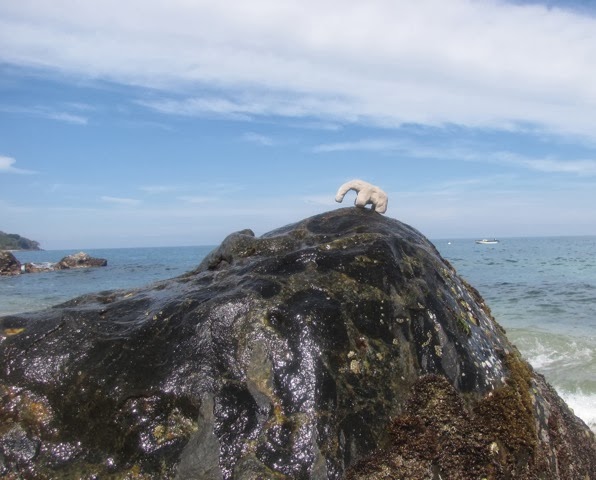
Christopher's elephants have appeared around the world in recent years, from India to Mexico. And sometimes his smaller elephants show up in rather eccentric places. Which, I'm pretty sure, is exactly where elephants like to be.


Elephant at the beach in Yelapa, Mexico.
Photo: Christopher Griffin
Image courtesy of Christopher Griffin


Over the past decade or more, Christopher's paintings and sculptures have been featured in solo and group exhibitions across North America. To see more of his work, visit his website at www.christophergriffin.ca


Elephant in drainpipe, Rideau Canal, Ottawa—February 2013.
Photo: Christopher Griffin
Image courtesy of Christopher Griffin


Elephant Lore of the Day
Since Christopher's elephants have shown up Mexico, I thought I'd write today about Precolumbian elephant sculptures.

Although scientists are fairly certain elephants have never roamed Central and South America, there are a number of Precolumbian finds that may suggest otherwise. If not elephants, perhaps the memory of some elephant-like antecedent was passed down through generations of artisans—until the representations became so stylized that it's become easy to dismiss them as anything but elephants.


Archaeologist Alfred Maudslay's drawing of glyphs at Copan, Honduras,
A.D. 400–800. In recent years, it has been suggested that the creatures on
either side are blue macaws, which are indigenous to the region.
Source: http://resrustica.blogspot.ca/2010/02/elephant-glyphs-at-copan.html


There is a lot of vaguely kooky speculation out there about the possibility of elephants lurking in South American jungles—and even roaming open lands in the United States—as recently as 500 years ago. Most scientists, however, believe that anything resembling an elephant died out in the Americas at least 10,000 years ago.


Precolumbian figure (no date given) described in an auction catalogue
as a "coati head fragment."
Source: http://s8int.com/WordPress/wp-images/pre%20co%20elephant.jpg


Not being a scientist, archaeologist or crypto-zoologist, I'll let you make up your own mind about this well-known trio of Precolumbian "elephants". To read one of the more comprehensive online articles featuring ancient elephants in the Americas, click here.

Elephant-shaped pot (no date given) described by
its home museum as a "toy".
Collection of the Museo antropolgĂ­a de Xalapa,
Xalapa, Mexico
Photo: Zecharia Sitchin
Source: http://www.sitchin.com/elephant.htm


To Support Elephant Welfare