Showing posts with label creativity blog. Show all posts

Saturday, 13 June 2015

Elephant No. 133: From the Archives: Playing Card


It's the weekend, and I'm taking it easy, so here is one of the early postings from the original Elephant a Day blog. Enjoy!

Today I felt like doing something quiet and sedentary, so I decided to make a traditional playing card.

Playing cards were invented in Ancient China around the ninth century A.D. By the eleventh century, they could be found throughout Asia, likely transported along the Silk Road. Ancient Chinese "money cards" had four suits: coins, strings of coins, myriads (10,000) of coins, and tens of myriads. Some scholars believe that the first playing cards in China might have been a form of actual currency.

Playing cards came to Europe in the late fourteenth century, probably from Mameluke Egypt. The Egyptian deck had 52 cards, with four suits: polo sticks, coins, swords and cups. Each suit had ten number cards, featuring "pips" or suit symbols. There were also three "court" cards: King, Deputy King and Under-Deputy.

The Egyptian deck may have influenced the design of East Indian cards, although some suggest that it might have been the other way around. Early Indian cards are quite distinctive: they are circular, intricately hand-painted, and have anywhere from eight to thirty-two suits.


Ganjifa cards, with ten suits showing the ten avatars of Vishnu
Nineteenth century
Los Angeles County Museum of Art
Source: http://en.wikipedia.org/wiki/File:Ganjifa1.jpg


By the late fourteenth century, the use of playing cards had spread across Europe. The earliest cards were individually handmade and expensive; however, by the fifteenth century, decks printed from woodcuts had begun to appear. Most early woodcuts were coloured after printing, either by hand or using a stencil. A deck usually had four suits, although five suits were also common. In Germany, the suits were hearts, bells, leaves and acorns. Italian and Spanish cards used swords, wands, cups and coins.

The four suits most commonly used today—hearts, spades, diamonds and clubs—originated in France around 1480. The club (trèfle, or clover, in French) was likely derived from the acorn on German cards; the spade, from the German leaf. Europeans also changed the court cards to represent European royalty: originally with King, Knight and Knave, and later with King, Queen and Jack.

At first, the King was always the highest card. As time went on, the Ace took on greater significance, eventually becoming the card with the greatest value. Some have suggested that this concept was given a boost during the French Revolution, when the peasantry wrested power from the monarchy. 

Court cards with mirror images were invented in the late eighteenth century. This was so that players would not be tempted to turn the court cards right side up, which might hint at the cards they held. The use of the manufacturer's logo on the ace of spades began during the reign of James I of England (1556–1625), who passed a law requiring an insignia to show that duty had been paid on the cards. Duty was paid on playing cards in the United Kingdom until 1960.

The most common size for playing cards is 2-1/2 x 3-1/2 inches (poker size) or 2-1/4 x 3-1/2 inches (bridge size). Traditionally, the Jack of Spades, Jack of Hearts, and King of Diamonds are drawn in profile—these are the "one-eyed" cards. The rest of the court cards are depicted full-face. The King of Hearts is the only King with no mustache, and is also typically shown with a sword his head, making him look as though he's stabbing himself.

For today's elephant, I decided to make a standard poker-sized card, based on the King of Hearts from the Bicycle Playing Card deck.


To start, I traced around one of the Bicycle cards. Expecting that I would screw up at least once, I made four blanks, all from inexpensive bristol board.


In order to create a mirror image of the Elephant King of Hearts, I drew a line across the middle of the card, then sketched in the elephant. Although I used the general idea of the King of Hearts from the Bicycle deck, I decided not to have the elephant stabbing himself in the head with a sword. Although the King of Hearts may traditionally be nicknamed the "suicide king", I didn't want a suicide elephant.


Drawing a mirror image freehand is actually more difficult than you'd think. Short of making a grid (which I knew I would greatly dislike), there's no easy way of doing this. What worked best for me was to draw a bit of the design on one half, then flip it around and draw as close to the same thing as possible on the other half. I guess I was hoping my fingers would have some sort of memory of what they'd just done. It wasn't always as precise as I would have liked, but it came out close enough.

I wanted something on the back as well, but the Bicycle Poker Card design is beyond what I can do on such a small surface with a limited amount of time. I did another mirror design with a few nods to the idea behind the Bicycle design, but it's nowhere near as detailed as the card that inspired it.


I had originally planned to use drafting pens for this. I had blue, red and black drafting ink on hand, and planned to fill the yellow in with coloured pencil afterwards. Unfortunately, the blue ink was old and not very cooperative, so after a few attempts with ink, I went with coloured pencil instead.

I wanted to stick more or less with the same colours as are on the Bicycle cards, so that's the colour palette I used.


I didn't get quite the crisp result I expected, but I certainly learned a lot about drawing mirror images. And old ink. And the propensity of coloured pencil to smudge. And how you can't erase lead pencil after you've put coloured pencil in the same vicinity.

It was definitely an interesting exercise. Just don't expect a pack of Elephant Poker Cards anytime soon.


Elephant Lore of the Day
In the French playing cards on which most modern decks are based, the King of Hearts is said to depict Charlemagne, Emperor of the Franks.

In A.D. 802, Charlemagne received an Asian elephant named Abul-Abbas from the Caliph of Baghdad. Abul-Abbas was brought from Baghdad by a man called Isaac, who had been sent to the Caliph on Charlemagne's orders. Following the deaths of the two other emissaries sent to Baghdad with him, Isaac returned alone with the elephant. The journey took many months: first by land along the Egyptian coast and across modern Algeria and Tunisia, then by sea from Tunisia to Europe.

Abul-Abbas was a big hit in his new home, and was exhibited many times at court. He was eventually housed in Augsburg, in today's southern Bavaria. Sadly, Abul-Abbas died of pneumonia when he was in his forties, likely from swimming in the Rhine. His bones were preserved at Lippenham, Denmark until the eighteenth century.

Some say that Abul-Abbas was an albino elephant. Legend also suggests that he was used as a war elephant in A.D. 804, when the Franks were attacked by the Danes. Mobilizing his troops, Charlemagne is said to have asked that Abul-Abbas be sent to him, so that the elephant could take part in the battle.


To Support Elephant Welfare

Thursday, 11 June 2015

Elephant No. 131: From the Archives—Altoids Tin Diorama


Over the past several years, people have been using Altoids tins to make lots of interesting things, from tiny amplifiers to little shrines to homes for itty-bitty animals. So today, I thought I'd try making something using an Altoids tin.

Altoids are strong breath mints that were first produced in England in the 1780s. Billed as the "Original Celebrated Curiously Strong Mints", Altoids are characterized by a high proportion of peppermint oil.

Interestingly, Altoids are harder to find in Britain than in the other countries to which they are exported. They have never been heavily marketed in Britain; however, in the United States they are so popular that the brand's owner moved Altoids production to Chattanooga, Tennesee, to be nearer the primary market.

In addition to the traditional mints—currently available in seven breath-freshening flavours—Altoids makes sour hard candies in round tins. Other items such as chewing gum, chocolate-dipped mints, and breath strips have also been marketed over the years, but have since been discontinued.


A selection of Altoid tins.
Source: http://en.wikipedia.org/wiki/File:Altoidstins1b.jpg


In addition to the mints, many people buy Altoids simply to get the handy little tins. Some people use them as simple containers for household items such as paper clips, little sewing kits and coins. Others use them as ashtrays, miniature survival kits and first aid kits.


Typical Altoids survival kit.
Source: http://www.fieldandstream.com/photos/gallery/survival/food/
2006/08/make-survival-kit-out-altoids-tin-and-two-more-life-saving-diy-


And then there are the people who think up wild and woolly ways of using Altoids tins. Even the most rudimentary online search for "Altoids tin" turns up inventive uses such as working amplifiers, flashlights, speakers, a thumb piano, a crystal radio, a barbecue grill, and even a projector.


Altoids tin projector, made by Leonidas Tolias.
Source: http://www.leonidastolias.com/Site/Pocket_Projector.html


Altoids tins are also a favourite plaything for artists. Shrines, dioramas, shadowboxes, zen gardens, coin purses, mouse houses and picture frames are just a few of the uses I've seen.


Elaborate altered Altoids tin by Laura Carson, 2011.
Source: http://artfullymusing.blogspot.ca/search/label/Altoids%20Tins


Although I'm a sucker for any kind of tin container, I only have two actual Altoid tins: one really small tin, and a regular-sized one. I had no idea what I was going to make for today's elephant, but I thought the larger tin might be more practical.


At first, I wasn't sure what kind of thing to produce. I'm by no means an electronic genius, or I would have tried to figure out how to make something that trumpeted like an elephant when the tin was opened. Or that lit up. Or that featured a little dancing elephant. I thought about making a little stuffed elephant tucked up in bed, but I didn't feel like sewing today. I felt like drawing and cutting things out, so I decided I would do some kind of elephant diorama, since I'm quite taken with mixed-media art created inside Altoid tins.

I determined at the outset that I didn't want to paint or otherwise alter the exterior of the tin. This wasn't laziness on my part, as much as a desire to preserve the original look of the tin. So I turned my attention to the insides.

A couple of days ago, a friend suggested that when I finish this yearlong adventure I should go bond with some elephants in Tanzania's Ngorongoro Crater. Just in case I can't afford it right away, I thought I'd try and make a mini-diorama of a similar scene to tide me over.

I traced out two shapes from artist-quality bristol board to fit into the upper and lower lids of the tin. Because I needed a backdrop for my scene, I then looked online for photographs of the landscape in the Ngorongoro Crater. This is what I came up with, although I won't put in quite so many trees.


Elephant in Ngorongoro Crater, Tanzania.
Photo: © Blake Harrington III
Source: http://blaineharrington.photoshelter.com/image/I0000uCj6rW1hJ4s


I drew everything first. For the upper lid, I drew a sort of postcard scene, with Mount Kilimanjaro in the background. Having never been to Tanzania, I'm not sure you can actually see Kilimanjaro from inside the crater, so I may be taking a bit of artistic license here. There are photos online that suggest that Kilimanjaro is visible from Ngorongoro, but you can't believe every caption you read.

For the lower section, I didn't draw anything, since I planned to paint the background freehand, along with a framing strip to go around the inside of the wall of the tin.


Next, I tried to figure out how many little figures I should insert into the scene. I wanted to stagger their placement in foreground and background, but it's a very shallow space, so I didn't go overboard. I drew the figures onto the same bristol board.


I heat-set all the drawings with a hairdryer, then painted everything. In the process, I added narrow tabs at the bottom of the little figures, so that they would stand up when affixed to the tin.


When everything was dry, I started by glueing the Kilimanjaro scene into the upper lid with double-sided tape. I did the same with the backdrop in the lower section, and added the framing strip all the way around. I had goofed a bit on one side of the framing strip, in terms of where the sky met the ground, but it wasn't horrendous.

After this, I cut out all the little bits, pre-folding the lower tabs against a metal ruler. I then glued each of the tabs with a glue stick, and placed them in what I thought was a pleasing arrangement on the lower part of the framing strip. I laid them flat to apply them, then folded each piece forward and creased it sharply.


It took me a while to make all of this, but it wasn't particularly difficult. And I didn't really mind, because it was the kind of thing I felt like doing today.


Although I wasn't sure when I started how well this would turn out, I'm happy with the final piece. In fact, I may just have to go out and buy some more Altoids, just to get the tins.


Elephant Lore of the Day
When she arrived at the Bristol Zoological Gardens in 1868, Zebi was the largest Asian elephant in captivity. Standing three metres (ten feet) in height, Zebi had been sent as a gift to the Zoo by the Maharaja of Mysore.

Zebi was a highly popular attraction at the time, particularly for her antics. She was no respecter of persons or their possessions, and appeared to take great delight in removing and eating whatever took her fancy. She had a particular taste for the straw hats popular among both men and women at the time. If she discovered a straw hat within reach of her trunk, Zebi would blithely pluck it from the wearer's head and eat it.

She also had an interest in wooden objects. Her most famous acquisition was a cricket bat carried by a young boy. Snatching the bat from the child, Zebi quickly reduced it to splinters, then ate it.

Although later elephants acquired by the Bristol Zoo gave rides to children, it doesn't appear as though Zebi ever allowed riders on her back. Sadly, following six months of ill health, Zebi was euthanized in 1910.


Zebi and her keeper Jim Rawlings, ca. 1901.
Photo: © PA
Source: http://www.metro.co.uk/news/pictures/photos-10722/pictures-
bristol-zoos-175th-birthday/2

Thursday, 17 October 2013

Elephant No. 45: From the Archives—Music Composition


I knew I wouldn't have time to make anything of my own today, so I decided to repost one of the more ridiculous things I produced for the original Elephant a Day blog.


It's Leap Year Day and Giachino Rossini's 220th birthday (no, that doesn't mean he would really be 880 years old), so it seemed like a perfect opportunity to try some musical composition.

My musician and composer friends are probably going to be aghast at this little experiment, but it's something I've wanted to try for a long time.

Not that I'm any kind of composer or musician—in fact, the very idea is laughable. In elementary school, I played the violin, once actually causing my private tutor Mr. Hursti to weep in despair. In middle school, I played the clarinet in a school band that should have provided poor Mr. Smith with noise-cancelling headphones instead of a baton. By the time I hit high school, my parents had wisely decided that I was the least musical of their children, and there were no more music lessons for me.

I vaguely remember how to read sheet music, but I've never composed anything before. I'm pretty sure I'm not composing anything today, either, but at least it looks like a piece of music.

My big idea for today's elephant was to place notes in an elephant shape on a piece of stave paper, then play it through a music program on my computer.

I decided to use simple quarter notes, and a single piano as the instrument. Putting any other kind of instrument on here would be far beyond my meagre powers: not only do I not know the software, but I tend to hear only one instrument at a time in my head. Also, if I were composing this in real life, it would likely be produced on a plinky red kiddie piano like Schroeder plays in the Peanuts comic strip.


Schroeder from the Peanuts comic strip by Charles M. Schulz
Source: http://peanuts.wikia.com/wiki/Schroeder


The first thing I did was get some composition and notation software. I chose a free download from Musescore.org which seemed to have all the features I needed.

Once I had an idea of how the software worked, I laid in a general elephant outline in quarter notes. Sometimes this gave me some nice harmonies, and other times it made me cringe. I adjusted what I could, and left what I couldn't, so there are still some brief moments of horridness—in a 34-second song, perhaps not brief enough. When I tried to put in some eighth-notes and so forth, it only made me mental and looked weird, so quarter notes and a single piano is what you get.

I did adjust a few elements in the design to avoid longish rests and single notes with no harmony or chord, but I didn't go crazy.

This is what the final sheet music looked like—feel free to laugh your heads off. To be honest, I don't even know if it's readable to a real musician. Only my computer knows for sure.


And this is what it sounds like. This blogging platform doesn't seem to support music files, so I whipped this off in iMovie. I only spent about five minutes on the video, so it's nothing special.


It was a ridiculous experiment on a day that shouldn't exist, but I was really curious about what something like this would sound like. It has moments that I like, and moments that make my teeth hurt. But it was fun and took less than an hour. More to the point, the sight of elephant-shaped music made me laugh, which is always the most important thing.

Happy birthday, Mr. Rossini. You must be turning over in your grave.


Greeting card from Zazzle.com.
Source: http://www.zazzle.ca/funny_elephants_playing_music_
birthday_card-137730508120914387


Elephant Lore of the Day
For centuries, people familiar with pachyderms have noted elephants' ability to distinguish melodies—a skill that has long been used with circus elephants. In most cases, the music cues portions of the elephant's performance; however, several circuses in the middle of the nineteenth century also featured "elephant bands", which one historian suggests probably sounded "like a herd of angry Buicks".

In 1957, German scientist Bernard Rensch reported in Scientific American that his test elephant could distinguish twelve musical tones, and could remember simple melodies, even when they were played at different pitches, timbres and meters, and on different instruments. Even more astonishingly, the elephant still remembered the tunes eighteen months later.

Elephants have much keener hearing than sight, and use a vast range of vocalizations when communicating—many of which are beyond human hearing. Interestingly, they also appear to have a sense of rhythm and repetition, and even dissonance.

In 2000, Richard Lair, who had worked with elephants for more than two decades, and neurologist David Sulzer (who composes and produces as Dave Soldier), launched the Thai Elephant Orchestra. Gathering six young elephants at the Thai Elephant Conservation Center, the two men showed the elephants how to make sounds on some elephant-sized traditional instruments. These included a gong, drums, a bass, xylophones, a thundersheet and harmonicas.


Pratida is considered one of the more musically inclined elephants
in the Thai Elephant Orchestra. Here she plays the drums.
Photo: Millie Young
Source: http://www.pathtorhythm.com


Once they had shown the elephants how to use the instruments, Lair and Sulzer left the elephants to make whatever kind of music they wanted, cueing them only to start and stop. Sulzer was skeptical at first, assuming that the elephants would simply bang about on the instruments, and that the recording would have to be cleaned up in post-production. Instead, to his astonishment, the performances were recorded intact, without overdubbing, and were paused only when outside sounds intruded.

In 2003, the Thai Elephant Orchestra released its first CD on New York-based Mulatta Records. Proceeds from the CD went to a milk bank for orphaned elephants, and a training school for Thai mahouts. To see and hear the Thai Elephant Orchestra in action, click here. And for a video featuring New Age cellist Jami Sieber and her experiences with the Thai Elephant Orchestra's musicians, click here.


Elephant playing xylophone at Thai Conservation Center, Lampang, 2005.
Photo: William Albert Allard/©2008 National Geographic Society
Source: http://photography.nationalgeographic.com/photography/enlarge/
elephant-xylophone-allard_pod_image.html


To Support Elephant Welfare
Boon Lott's Elephant Sanctuary (Thailand)
Wildlife SOS (India) 
 
The Elephant Sanctuary (Tennessee)

David Shepherd Wildlife Foundation

Tuesday, 3 September 2013

Elephant No. 1: Keith Haring Elephants


A new blog . . . and new elephants . . .

After nearly a year of making no elephants at all, it felt like time to start again. If you're familiar with the original blog, you'll find the format for An Elephant a Day 2.0 very similar: lots of elephants made by me, along with elephant lore and links to elephant charities. This time around, however, I'll be including elephants made by others—in other words, elephants made by you.

Show the world what you can do, no matter how silly you think it is. If you need reassurance that your idea isn't too weird, you'll feel better when you see some of the bizarre things I've made.

If you don't want to make anything, consider sharing one of your elephant treasures with the world, and tell us the story behind it. And if you do want to make something, but your talents don't lend themselves to the visual arts, send music or video clips, or tell the world about your encounter with an elephant, or relate an elephant story you've heard, or even update us on elephant conservation efforts around the world.

To share your work, send a message via the Elephant a Day Facebook page here. I'll be curating the selections I receive—giving credit where credit is due, of course—and may edit written material slightly for length or content before posting it on this blog. But the idea is to open up the blog to the wider world. I have yet to meet a person who doesn't love elephants, so I'm betting that there's a lot of great content out there.

In the meantime, here's my first new elephant. When I asked several people what they'd like to see in this rebooted blog, I gave them two main options for my own contributions: an elephant a day in the style of a different artist each time, or more elaborate elephants that took me longer than a day. Opinion was more or less evenly split between the two, so I'm doing a combination of both. Today's elephant is inspired by pop/graffiti artist Keith Haring.


Pop  Shop IV—Series of 4 Prints by Keith Haring (1958–1990)
Source: http://www.artnet.com/artwork/426222152/425490280/
keith-haring-pop-shop-iv---series-of-4-prints.html

Haring's art is characterized, first and foremost, by bold lines and bright colours. Although in later years he would often fill in his figures and backgrounds with a welter of almost mystical lines and symbols, he never lost his love of line, colour and deceptively simple shapes.

Today I produced two different Haring-style elephants. For materials, I used cheap acrylic paints, straight from the bottle; two mid-range paintbrushes—one fine, one medium; and two inexpensive canvas boards. The three-colour elephant is on a 5 x 7-inch (12.7 x 17.8 cm) board; the two-colour elephant is on a 9 x 12-inch (22.9 x 30.5 cm) board.

Keith Haring rarely, if ever, sketched anything out, so I bit the bullet and "drew" with my paintbrush. This sort of thing always gives me the heebie-jeebies, because I'm not particularly confident or bold in style. The other hard thing was keeping a relatively uniform line, because I really, really like to vary the weight of my lines when I draw or paint. The photos below show my two basic outlines. 


Because Haring used bright, solid colours, I knew I wouldn't be able to shade anything. This is also something I find hard to avoid. It was difficult for me not to want to use brushstrokes to shape the paint at least a little. But I forebore. This is what the elephants looked like with the colours blocked in.


The final touch was adding the little lines of movement and radiance that were so characteristic of Haring's work. This is not as straightforward as you'd think. If you're really trying to channel Haring, do you show movement around all four limbs? How many lines at each spot? Do you vary the length of the line everywhere? When are there enough lines? When are there too many?


For this first elephant in the new blog, I didn't choose Haring because I thought he'd be easy, but I also didn't think he'd be quite so complicated. Speaking of which, I have a running argument with a woman of my acquaintance who doesn't believe it necessary to learn the basics of any technique. She would likely take one look at Haring's work and declare it simple enough that any child could do it. And she would be wrong—well, unless she considered Haring a particularly, er, Radiant Child.


To follow an abbreviated version of this blog on Tumblr, click here.


Elephant Lore of the Day
Early on in the previous blog, I wrote about the seriously endangered Sumatran elephant and the spectre of its looming extinction. A few weeks ago, however, the World Wildlife Federation posted a story about a baby Sumatran elephant born to the WWF Flying Squad.

The biggest problem facing Sumatran elephants is conflict with humans, as elephants often stray into populated areas, or onto plantations. Enter the Flying Squad. The Flying Squad is actually a group of trained elephants and their mahouts, serving as a "thin red line" between wild elephants and humans. The Flying Squad—created by the WWF and the Indonesia Ministry of Forests in 2004—essentially heads wild elephants off at the pass, thus preventing them from coming into conflict with humans. In Sumatra, this is critical, as three wild elephants have been killed already this year, and 12 were killed in 2012. Almost all were poisoned.

Although a rise in the wild elephant population would be even greater cause for celebration, any increase in the Sumatran elephant population is fantastic news. You can read the full story here.


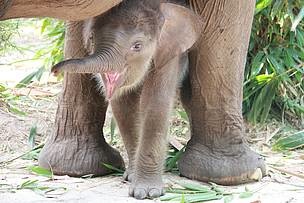
Female Sumatran elephant calf born August 9, 2013
in Tesso Nil National Park, Indonesia.
Photo: © WWF-Indonesia/Wishnu Sukmantoro
Source: http://www.wwf.ca/?13601/calf-born-to-indonesias-elephant-flying-squad#


To Support Elephant Welfare
Boon Lott's Elephant Sanctuary (Thailand)
Wildlife SOS (India) 
 
The Elephant Sanctuary (Tennessee)