Showing posts with label sculpture. Show all posts

Wednesday, 22 April 2015

Elephant No. 127: Little Telephone Wire Elephant


On the way back from taking my car in for spring servicing today, I noticed a pile of colourful wire scraps on the ground. The pile was in front of a telephone switching box, so I assumed it was left over from recent work.

My first thought was, "I wonder where I can get coloured wire like that for jewellery-making?" My second thought was, "Go back and pick it up, because you could probably make a wee elephant out of it." So that's exactly what I did.

I washed it to remove any residual cooties, then assessed what I had. It wasn't a lot to work with, but I figured I could do something. 


I began by making a body and legs, without much real attention to detail. As long as it stood up, I was happy.


Next, I added a head, trunk and tusks.


To finish it and use up every last bit of wire, I took whatever was left of the yellow and began wrapping  it around willy nilly.


It's not the best wire elephant I've ever made, but I kind of like it. It only took me about 15 minutes, measures a mere 1-1/2 inches (3.8 cm) from tip of the trunk to tip of the tail, and it's concocted of sidewalk litter. I wasn't looking for an Earth Day project, but perhaps one was looking for me.


Elephant Lore of the Day
Since it's Earth Day, please spare a thought for endangered pachyderms around the world. Several species of rhinoceros (yes, they're also pachyderms) have become extinct in the past few years, and the world's last male Northern White Rhino has not only been stripped of his horn for his own safety, but lives under constant armed guard.

As for elephants, the African elephant is under such threat from ivory poachers that, although its current population is estimated at 400,000, it could become extinct by 2020. Asian elephants are similarly under threat from factors such as habitat loss and human-elephant conflict.

Please spare a thought as well for the brave and committed men and women who devote their lives to protecting wildlife. It isn't an easy job, particularly on the front lines in the war between poachers and conservationists. Poachers are now well funded and highly organized, and have no compunction about killing rangers who get in their way. In Kenya alone, as of October 2013, more than 60 rangers had been killed protecting wildlife.


Family of African elephants.
Photo: © Martin Harvey/WWF-Canon
Source: World Wildlife Fund


To Support Elephant Welfare

Tuesday, 27 January 2015

Elephant No. 116: Buttons and Pipe Cleaners


I saw this idea in Martha Stewart's Favorite Crafts for Kids. The examples in the book were Christmas-related, but the principles looked like something I could adapt to make an elephant.

I have massive jars of buttons, so I just needed to buy pipe cleaners. I wasn't sure what would inspire me, so I bought a few in various colours and thicknesses.


I began by folding a grey pipe cleaner in half, then twisted a small loop at the end, where the tail would eventually go.


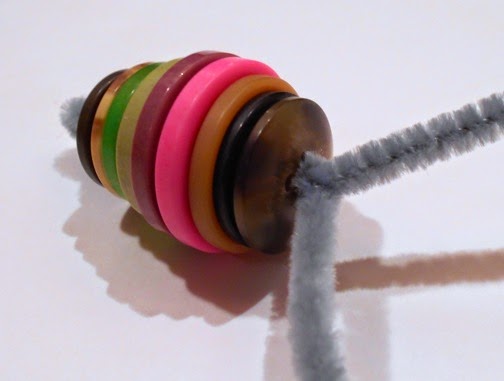
Next, I added buttons in various colours to make a fat body, by feeding both stems through holes in the buttons. If your buttons have four holes (as most of mine did), use holes that are diagonal to one another.


I made a twist at the front to hold the body together.


Most of the examples in the book are sort of button cylinders, with appendages such as legs and ears and tails made using pipe cleaners. I had a lot of very small buttons, so I decided to make the trunk as an extension of the head. At the end, I made two twists, then cut off the ends, twisted them again with a small pair of pliers and flattened them a bit to push in the sharp cut ends.


I also decided that, since elephants have thick, straight legs, I'd make those out of buttons, too. For each leg, I cut a pipe cleaner in half, and pushed both halves between the third and fourth button from the tail, and the third and fourth button from the head. Note that you need two stems on each side to hold the buttons in place.


I pulled both of them up and around to lock them around the main body pipe cleaner stem, but you can skip this step if you like.


To finish the ends of the legs, I did the same thing I'd done with the tip of the trunk.


I also added a small tail by twisting one of the pipe cleaner offcuts through the loop at the back of the body. I also gave it a bit of a kink.


And because an elephant is not an elephant without big, floppy ears, I cut another pipe cleaner in half and twisted both halves together around the gap between the body and head.


I chose a couple of big buttons, and finished the ends.


All of the elephants I make tend to be a bit top-heavy because of the trunk. To counteract this, I have a few tricks:

• Make the front legs ever so slightly longer, which tips the elephant back a bit.
• Splay the back legs slightly, and push the front ones closer together.
• Raise the elephant's trunk as much as possible.
• All of the above—which is what I did here.

This was easy and fun, and the end result is eccentrically cute, which is something I generally like to see in my growing herd.


Elephant Lore of the Day
Despite an elephant's size, it can be brought down by predators other than humans. In November 2014, tourists in Zambia's South Luangwa National Park watched in horror as a young elephant was attacked near a waterhole by 14 hungry lionesses.


A young elephant is attacked by 14 lionesses.
Photo: Caters News Agency
Source: Daily Mail

For a time, it looked as though the lions had managed to bring the elephant down.


The lionesses bring the elephant to his knees.
Photo: Caters News Agency
Source: Daily Mail


Suddenly, however, he rallied and ran into the water, where the lionesses had to decide whether they wanted the elephant enough to get a soaking. Most of them decided not.


The elephant shakes the elephants off in the water
Photo: Steve Baker
Source: Daily Mail


After his quick dip in the water, the elephant emerged refreshed, and chased off the last of the lionesses. It was later discovered that the lions had killed a water buffalo instead. To read the full story, click here.


Reinvigorated, the elephant chases off the last of the lionesses.
Photo: Caters News Agency
Source: Daily Mail


To Support Elephant Welfare

Saturday, 24 January 2015

Elephant No. 113: Damien Hirst Elephant


Damien Hirst is perhaps the best-known of the group dubbed the Young British Artists (YBAs). A Conceptual artist who came to prominence in the 1990s, Hirst is perhaps most famous for glass cases containing animals preserved in formaldehyde.

Sometimes they are whole, as in The Physical Impossibility of Death in the Mind of Someone Living: a tiger shark measuring nearly 14 feet (4.3 metres), suspended in a large vitrine. Others are dissected and preserved for Hirst by skilled taxidermist Emily Mayer. Mayer, who is a talented artist herself, uses a fascinating process that essentially replaces organic structures with a plastic resin.


The Physical Impossibility of Death in the Mind of Someone Living, 1991
Damien Hirst (1965– )
Collection of the Metropolitan Museum of Art, New York City
Photo: Prudence Cuming Associates © Damien Hirst and Science Ltd.
Source: damienhirst.com

To some, Hirst isn't really an artist at all, but a Conceptual bad boy who has learned how to poke a finger in the eye of the art establishment, becoming rich and famous in the process. In addition to his preserved animals, he has produced "spin paintings" using a mechanism like the popular Spin Art child's toy, and "spot paintings" which consist of coloured circles made by his assistants.


The Incredible Journey, 2008
Damien Hirst (1965– )
Part of the exhibition, Beautiful Inside My Head Forever
Photo: Prudence Cuming Associates © Damien Hirst and Science Ltd.
Source: damienhirst.com


Over the years, Hirst has been accused of plagiarism, and of being an artistic sell-out. Art critics also tend to be underwhelmed. Robert Hughes of TIME Magazine famously wrote of Hirst's shark, "One might as well get excited about seeing a dead halibut on a slab."

Despite the controversy that dogs him, however, there is no doubting Hirst's success. In 2007, his sculpture For the Love of God sold for £50 million (about $100 million). Consisting of a platinum cast of an 18th-century skull, real teeth and 8,601 flawless diamonds, the piece cost £14 million to produce. A year later, he sold an entire exhibition's worth of art, called Beautiful Inside My Head Forever, for £111 million.


For the Love of God, 2007
Damien Hirst (1965– )
Whie Cube Gallery, London
Photo: Tyrenius
Source: Wikipedia


Making today's Hirst elephant was, of course, going to be dead simple. Or so I thought.

I started by buying this glass vase for three dollars at the dollar store.


I began by washing it to make it as clear a showcase as possible.

I also bought a pack of cheap animals at the dollar store. Plastic animals are often terrible unless they cost about five dollars each, but this elephant looked surprisingly good to me.


I put little pieces of plastic modelling clay on each of the elephant's four feet, and stuck it to the bottom of the container.


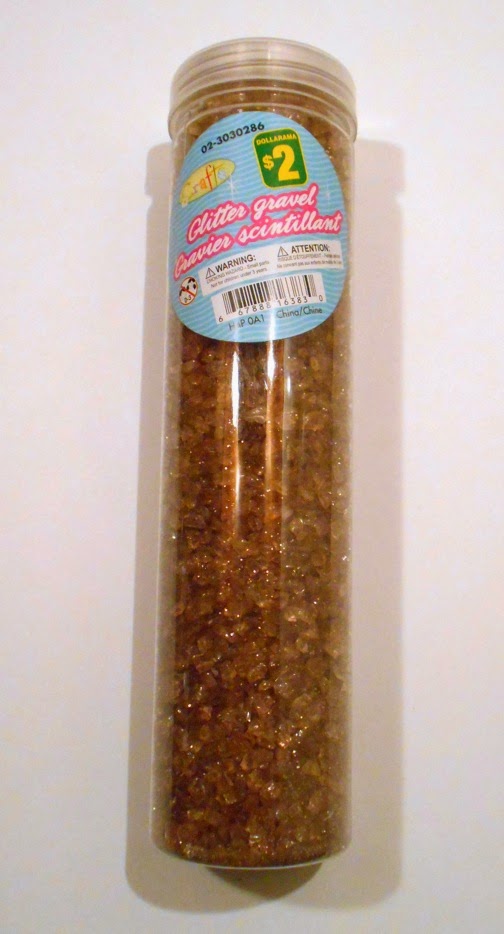
To make it a little less bland, I add a sprinkling of something called "glitter gravel".


I filled the container with water that I had pre-coloured with blue food colouring, since all of Hirst's animals seem to be suspended in blue liquid. I used a scant drop of blue food colouring for about eight cups (2 litres) of water.


One thing I hadn't reckoned on, however was the presence of air bubbles. They were everywhere: clinging to the sides of the vase, to the gravel, and to every single surface of the elephant. I tried gently bumping the whole thing on a hard surface but, while a few bubbles rose and popped, most of them stayed where they were.

Eventually I used various paintbrushes to stroke the bubbles off the elephant. I couldn't get at some of the bubbles, but I'm hoping they'll eventually dissipate. For now, I'll pretend I meant it to have a few fine bubbles.


No work of Conceptual art is finished, of course, until it's given a name. I wanted something suitably Hirstian, which to me means lengthy and obtuse. I settled on If I Believe in Forever, I Can See For Miles. Makes no sense at all, but it sounds cool.


Elephant Lore of the Day
Throughout history, elephants have been preserved by taxidermists. Centuries ago, this usually involved building a wooden and/or metal form, over which the skin would be stretched. The elephant would then be stuffed and given relatively lifelike features such as glass eyes. As you can imagine, this often resulted in some rather grotesque creations, many of which rotted and split, making the effect even worse.

Peculiarly, circus owners often stuffed deceased elephants and took them on tour, along with their live elephants. And some particularly unpleasant characters, unused to the costs and difficulties of caring for an elephant, killed their star attraction and had it stuffed.

Following the death and stuffing of the unpredictable Tusko by his new owner, his former handler wrote bitterly, "No hay to buy, no elephant man to put up with, and best of all a completely docile Tusko he could handle himself."


Preparation of an elephant skin for display at
the American Museum of Natural History, early 20th century
Source: scienceblogs.com


To Support Elephant Welfare

Sunday, 17 November 2013

Elephant No. 76: Glass Canes


I bought a bag of something called "glass gems" for my original Elephant a Day blog and never used them, so I thought I'd finally try making something with them today.


They looked interesting enough in the package, but when I poured them out, I realized it was going to be difficult to make an elephant out of them. Aside from a few slightly rounded pieces, most of the glass was sticklike, meaning that making an elephant was going to be about as much fun as making an elephant from popsicle sticks. Sigh.


I used clear marine silicone to glue things together, as I figured it would be the most likely thing to form a permanent bond with glass. I think this is what I used to make an elephant from marbles in the original Elephant a Day blog.


I started by gluing two pieces together for the elephant's back. So far, so good. The silicone takes about a half-hour to form a bond strong enough to allow you to move on, so I worked on different parts of the elephant concurrently.


I worked on the head next, which was a bit of a pain. The head itself is made up of three layers of glass, surrounded by three ear "sticks" on each side. The head sandwich was easy enough, but keeping the ears together required me to do one side at a time, propped up with other bits of glass to keep it from collapsing while it set. The trunk, on the other hand, was a breeze.


While the head was sorting itself out, I added a pair of glass curves to the lower body, along with some legs. The legs were also a huge pain, and had to be detached and reattached so often that I nearly gave up on them. And, although I tried to splay them enough to allow the elephant to stand up, they didn't stay that way, no matter what I did.


I attached the body and head next, which required a great deal of propping up and binding together while it set. It collapsed so many times that this whole thing almost ended up as a pile of colourful powdered glass.

To finish the elephant, I stuck on a broken bit for a tail. This was probably the easiest part of the entire exercise.


It looked interesting when it was all put together, but it was incredibly messy. There was a film of silicone over everything—and once silicone is stuck to glass, it wants to stay stuck. I must have spent at least two hours scraping away errant bits of silicone so that the glass would be shiny again, and so that it didn't end up with raggedy blobs of silicone all over the place.

In the end, I like the way it turned out as an object, but I would be very reluctant to try this again. It took too much propping up, fell apart too often, and took too long to clean up. And it doesn't stand up.

Then again, it looks pretty in a window—and I still have almost an entire bag of glass left to play with—so I suppose never say never.


Elephant Lore of the Day
In Chartres Cathedral in France, elephants are among the few exotic animals featured in the stained-glass window depicting the story of Noah.

Seen approaching the ark from the righthand side, about a third of the way up the window, the elephants have tiny mouse-like ears, and are primarily recognizable by their tusks and long noses.

Given that Chartres Cathedral was built between A.D. 1194 and 1250, the artists who produced the stained-glass windows would likely never have seen an actual elephant, and would have had only anecdotal descriptions and other equally erroneous depictions to go by.

That being said, I love this pair of elephants. Who knows: it may even inspire me to finally try my hand at stained glass.

Animals approaching the ark, two by two.
Noah Window, Chartres Cathedral, France, ca. A.D. 1205–1235
Source: http://www.medievalart.org.uk/chartres/47_pages/Chartres_Bay47_key.htm


To Support Elephant Welfare