Showing posts with label food and drink. Show all posts

Thursday, 29 January 2015

Elephant No. 118: Amarula


I've been seeing billboards for this liqueur around town for the past couple of years, so I finally decided to buy some.

Amarula is made from the fruit of the Marula Tree (Sclerocarya birrea), which is sometimes known as the Elephant Tree. The fruit is related to the mango, and is about the size of a small plum. Native to southeastern Africa, the fruit is described as having "a citrus tang with a creamy nutty taste."

Marula fruit ripens in mid-January to mid-March, when it is harvested by humans. It is also eaten by a wide range of animals, including rhinos, warthogs, baboons, monkeys, porcupine, zebra, antelopes—and of course elephants.

In addition to being a favourite fruit of African elephants, the marula has been dubbed the "fruit of kings." Some communities make a marula drink that is offered to the spirits of their ancestors. Among some peoples, the marula is known as the "marriage tree" and weddings are held in its shade. Some groups also light fires with marula twigs when babies are born, to give both baby and mother qualities such as tenderness.


Marula fruit.
Source: Amarula.com


The tree has medicinal properties, partly due to the antihistamines contained in its bark and leaves. These are used to treat rheumatism, insect bites, skin infections and stomach problems. In addition, a decoction of the fruit is sometimes used to treat tick-infested livestock.

Oil from the fruit's kernel is used as a food supplement, and the kernels are often eaten whole or ground into porridge. The oil can also be used as a candle substitute. The skin of the fruit is often boiled to make a drink or a plant food, and the wood of the fallen tree is turned into furniture, bowls, and implements such as mortar and pestle.

So, what does it taste like? I'm not much for hard liquor and mixed drinks, but in the interests of research, I poured myself a swig.


It's actually very nice. It has the tastes of both fruit and cream, and is definitely strong. It's a bit like Bailey's Irish Cream, although a little more subtle. It's not too sweet or too cloying, and has a pleasant fruity aftertaste. I could be persuaded to quite like it.

I like that the back of the bottle has a wee elephant embossed into the shoulder.


And that the cap has an elephant on it.


To read more about the marula tree and Amarula liqueur, please visit the excellent Amarula website, which includes an extensive recipe book, as well as information on elephant welfare activities supported by the Amarula Trust.


Elephant Lore of the Day
My first thought when I saw the billboards for Amarula was, "Not that old chestnut. Elephants do not get drunk on marula fruit." I was wrong about the reason for the liqueur's name, but not wrong about the fact that elephants do not get drunk on fermented windfall marula.

As late as 2014, African travel brochures, tourists, and YouTube videos were suggesting that elephants got tipsy on the rotten, fermented marula they plucked from the ground. Because it's such a catchy idea—animals get drunk like us!—it's a concept that is proving surprisingly resilient.

As early as 2005, however, a study described in National Geographic had effectively put that idea to rest. It was discovered that elephants don't actually go for the fruit that falls onto the ground. Instead, they pluck the fruit right from the tree, or shake the tree until fresh fruit falls. So, no fermented fruit for picky elephants with champagne tastes.

In addition, the fruit that the elephants do eat passes through their system too quickly to ferment even in their gut. This is, of course, assuming that an elephant could eat enough marula to produce an astonishing 7.1 gallons (27 litres) of fermented marula juice in its stomach, which is what it would take to make it drunk. Given that it takes 200 marula fruits to make one gallon, an elephant would have to ingest more than 1,400 marula fruits—all at the same time.


Elephant eating from a marula tree.
Photo: Thinkstock
Source: bbc.com


To Support Elephant Welfare


Wednesday, 7 January 2015

Elephant No. 96: Dead Elephant Beer


My sister came across this in a local liquor store a couple of months back, and bought it for me. I'm not much of a beer drinker, so she drank the beer (which she apparently didn't care for), then passed the can along to me.

When she first told me about it, and that it was made by the Railway City Brewing Company in in St. Thomas, Ontario, I figured right away that it was probably named for Jumbo, the famous elephant who died there. And I was right.

The back of the can reads:
Here's to Jumbo, world's largest elephant, friend and prized attraction of P.T. Barnum's traveling circus. It was 1885 here in St. Thomas where he met his early demise in a tragic railway accident that'll be forever remembered in the annals of beer and Canadian history. In his honour we've crafted this full bodied ale. Live Life Large. He'd have wanted it that way. And for you to drink responsibly.
 Along with this: A Jumbo legend with an unforgettable taste!


Okey dokey, then.

I'm not so sure that Jumbo will be forever remembered in the annals of beer, unless this particular brew becomes a massive hit, but his story is indeed famous. The account below is a shortened version of elephant lore I used in my original Elephant a Day blog.

Born in 1861 in Mali, West Africa, Jumbo was first imported to a small Paris zoo. In 1865, he was transferred to the London Zoo, where he became a popular attraction. It was here that he was also given his name, which is a variation on either the Swahili word jumbe, which means "chief" or jambo, which means "hello".

In 1882, Jumbo was sold to the Barnum & Bailey Circus for the then-exorbitant sum of $10,000. When P.T. Barnum first offered to buy the elephant, 100,000 British schoolchildren wrote to Queen Victoria, begging her to keep Jumbo in Britain.


Source: http://virtualvictorian.blogspot.com/
2010/06/story-of-jumbo-elephant.html


Jumbo was indeed a very big elephant. By the time of his death, he was claimed to measure four metres (13.1 feet) in height, and weighed 5.9 tonnes (13,000 pounds). During his lifetime, his size would make his name synonymous with anything large—a trend that continues to this day.


Jumbo's arrival in America.
Source: http://virtualvictorian.blogspot.com/
2010/06/story-of-jumbo-elephant.html


Sadly, Jumbo died in September 1885, when he was accidentally hit and wounded by a locomotive in St. Thomas, Ontario, Canada. It was suggested that he had died saving the younger circus elephant, Tom Thumb—although not all witnesses agreed. Peculiarly, Jumbo's stomach was found to contain numerous metallic objects, including coins, keys and metal rivets.

Following his death, Jumbo's hide was stuffed and travelled with the Barnum & Bailey circus for several years. It was later donated to Tufts University in Massachusetts, where it was displayed until it was destroyed by fire in 1975. His heart was sold to Cornell University, and his skeleton was donated to the American Museum of Natural History in New York City.


Elephant Lore of the Day
Elephants are known to love alcoholic drinks. It is probably the sugar that attracts them, and they have been known to wreak havoc if prevented from bellying up to the bar. They can also be rather belligerent drunks.

In November 2012, the Times of India reported on the destruction caused by a herd of 50 inebriated elephants. After drinking some 500 litres (100 Imperial gallons) of Mahua liquor from a shop in rural Dumurkota, India, they ransacked adjoining huts looking for more of the tasty beverage.

Drawn out of the forest by the smell of the liquor, they destroyed the shop, several homes and crops before villagers were able to drive them off. Forestry officials finally coaxed them across a nearby river.

According to police spokesman, Asish Samanat, because the herd lives in close proximity to people, they recognized the smell of the drink. He described the rowdy elephants as being similar to drunk humans, in that they were "aggressive and unreasonable, but also "much, much bigger." He also noted that they'd "have one heck of a hangover."


Asian elephants at a salt link in India.
Photo: Manoj Shah—Riser/Getty Images
Source: http://www.britannica.com/EBchecked/topic/285699/Asian-elephant


To Support Elephant Welfare


Thursday, 16 January 2014

Elephant No. 85: Tea Cozy


This year's challenge in my fibre arts guild was tea cozies. Although I'm a tea drinker, I usually make it by the cup, so tea cozies are not really my thing. You have to admit, however, that a teapot does bear a certain resemblance to an elephant, so this particular challenge seemed tailor-made for me.

I was going to use a pattern for this, but the only elephant tea-cozy pattern I found wasn't quite what I wanted. So I decided to wing it. I'm not the kind of person who whips off fantastically clever knitted things without a pattern, but I figured I could probably manage some kind of rounded shape, a trunk, some ears and a tail.

I planned to "full" or felt the elephant components in my washing machine, so I needed yarn that was 100% wool and/or other animal fibre. I had some yarn from a stash exchange that looked like it might work. Unfortunately, it had no label, so I burned a bit to test it. According to a study I found online, if a fibre "flames up then snuffs itself out quickly, leaving a small, easily crushed bead of carbon," it's wool. Okey dokey, then.


I wanted a smallish elephant, so I chose the second-smallest teapot we have.


These were the pieces I knitted. I used large (7.5 mm) needles to make everything spacey enough to allow for shrinkage. I added a green party hat to the mix, as I wanted to end up with a party elephant.


I tossed everything into my top-loading washing machine, and ran it through a long cycle with hot water, a bit of laundry soap, and lots of agitation. Then I did it again. And again. And again. Actually, I lost count of how many cycles it took. I began to loathe this project.

Eventually I ended up with pieces I could live with. The yarn turned surprisingly fluffy and shed like a Persian cat, but there was no way I was going to knit everything again, so I made the best of it.


I stitched the grey parts together, then needlefelted a few details onto the elephant, including an eye, a black tip to the tail, some pink inside the ears, and the all-important pink toenails. (I know at least two people who will agree about the toenails.)


At this point, it looked to me a bit like a mutant mouse or a jerboa, but I didn't really see how the shape would accommodate something more elephant-like, so this was going to have to do.

Sadly, the green hat I'd knitted was far too big. I tried needlefelting it to make it smaller. That didn't work, so I cut it apart and tried to sew it back together, but it looked weird. So I decided to needlefelt a new one. I also needlefelted a little blue bird to perch on top.


In addition to a party hat, I needlefelted a party blowout. I was crazy enough to make this as a flat strip, then decorate it, roll it and add a mouthpiece.


Finally, I made a pair of balloons that I wired around the elephant's tail. I like to make my needlefelting things free of anything but wool, so the balloons needed to be a bit on the small side, or they'd droop on the wire. The size kind of bugged me—but not enough to start over with a piece of styrofoam on the inside.


I still think it looks like a mouse or some other kind of rodent, but I don't hate it. However, if I were ever to do this again (and we won't hold our breath), I would probably choose a different type of teapot, or a more conventional half-moon tea cozy shape.


Still, as an anti-tea-cozy tea cozy, this works for me. And in the end, it's kind of cute.


Elephant Lore of the Day
On March 24, 1939, an elephant was welcomed into the Robur Tea Room for a special tea party. Sadly, there are no details on what prompted the owners to invite an elephant to tea, nor has the name of the elephant been recorded for posterity.


Young elephant from the Taronga Zoo in Sydney, Australia entering the
Robur Tea Room for the Elephant's Tea Party, March 24, 1939.
Photo: Sam Hood
Collection of the State Library of NSW
Source: http://acms.sl.nsw.gov.au/item/itemLarge.aspx?itemID=23304


After doing a bit of online research, however, I think this might be Sarina, who was somewhere between six and nine years old in 1939. According to a newspaper article printed that year, Sarina was about six and a half feet tall, which would make her just about the right size to fit through the tearoom door. Her fellow elephants at the Taronga Zoo in Sydney—Jumbo, Jessie and the famous Queenie—were all much older and larger at the time.


Young elephant enjoying a large cup of tea, Robur Tea Room,
Sydney Australia—March 24, 1939.
Photo: Sam Hood
Collection of the State Library of NSW
Source: http://acms.sl.nsw.gov.au/item/itemLarge.aspx?itemID=23311


If this is indeed Sarina, she is arrived at the Taronga Zoo in either 1936 or 1938, and is thought to have been born on the island of Singapore. Caught in the wild, she was apparently sent to Thailand (then known as Siam), later ending up at the Taronga Zoo. She died in 1971 of unrecorded causes.


Young elephant at the Robur Tea Room, Sydney, Australia—March 24, 1939.
Photo: Sam Hood
Collection of the State Library of NSW
Source: http://acms.sl.nsw.gov.au/item/itemLarge.aspx?itemID=75203


To Support Elephant Welfare


Sunday, 10 November 2013

Elephant No. 69: Coffee Grounds


For some reason, my husband Terrence left a French press full of dry, unpressed coffee grounds when he went out of town a few days back. Since I don't really drink coffee, I decided I'd save them to make an elephant design.

I've seen commercials on television that use coffee grounds to make animations. I did toy with that idea, but I didn't really have an easy way to set up a camera on an overhead tripod, and I figured that it would require more time and expertise than I have handy today.

I had this much coffee handy, which is the equivalent of a small handful of beans, ground at home for a French press.


I began by spreading them out a bit.


Then I decided that I would try doing an animation, after all. You can see the result below. Jumpy and a bit uneven, but done in under an hour with a handheld camera that was not behaving well today. On the other hand, "jumpy and a bit uneven" perfectly describes me when I've had too much coffee.


Obviously this would have worked better with some interstitial reshaping of the coffee grounds, but it's still kind of fun. As my first stop-motion animation thing ever, it wasn't nearly as hard as I expected it to be, and I may even try it again sometime.


Elephant Lore of the Day
If you've heard of the mighty expensive civet-dropping coffee (kopi luwak) from Indonesia, you may not be surprised at the idea of coffee made from elephant-excreted coffee beans.

Black Ivory Coffee is made from coffee berries that are consumed by a herd of 20 elephants in northern Thailand, then plucked the next day from their dung. Said to be "earthy in flavour and smooth on the palate," the coffee is the brainchild of Canadian Blake Dinkin.

Why elephants? Part of it is apparently due to biology. According to Dinkin, an elephant stomach is like a slow cooker. "When an elephant eats coffee," he says, "its stomach acid breaks down the protein in coffee, which is a key factor in its bitterness. You end up with a cup that's very smooth, without the bitterness of regular coffee."


Blake Dinkin with some of the elephant-digested coffee berries.
Photo: Apichart Weerawong/Associated Press
Source: http://business.financialpost.com/2012/12/17/elephant-dung-coffee-
black-ivory-becomes-worlds-most-expensive-brew/

Conservationists at the refuge where the elephants live were initially leery of the idea. John Roberts, director of elephants at the Golden Triangle Asian Elephant Foundation, wondered at first about the impact of caffeine on an elephant's surprisingly delicate constitution. "My initial thought," he says, "was about caffeine—won't they get wired or addicted to coffee?" Luckily, it appears that there is no harm at all to the elephants.

Black Ivory Coffee currently sells for an amazing $1,100 per kilogram ($500 a pound), and about $50 a serving. Why so expensive? Part of it is because the process is labour-intensive, from growing the coffee, to picking the dung apart, to extracting the beans themselvs. It also takes approximately 33 kilograms (72 pounds) of raw coffee berries to produce a single kilogram (2.2 pounds) of coffee, largely because most of the beans get chewed up, broken or lost in the tall grass.

Black Ivory Coffee is now available at a few luxury resorts in places like the Maldives and Abu Dhabi, and in northern Thailand, right next to the Foundation. Dinkin gives 8% of the proceeds from the sale of Black Ivory Coffee to the Foundation and its elephants, helping the elephants to essentially support themselves. To my mind, it's a much better way for Thailand's elephants to earn a living than street begging or performing tricks for crowds.

To read more, click here. To learn more about Black Ivory Coffee, visit their website at blackivorycoffee.com.


Meena the elephant sniffs at some Black Ivory Coffee sipped by Miki Giles.
Photo: Paula Bronstein/Getty Images
Source: http://business.financialpost.com/2012/12/17/elephant-dung-coffee-
black-ivory-becomes-worlds-most-expensive-brew/

To Support Elephant Welfare

Saturday, 9 November 2013

Elephant No. 68: Mini Babybel Cheeses


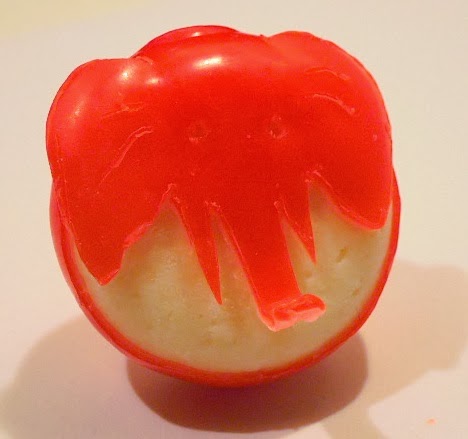
This idea was sent to me by Annie Carruthers, who always finds great ways to help me play with my food. Although I shaped things with the red wax on Babybel cheeses when I was a teenager, I'd never thought of cutting shapes into it. To see the original inspiration, click here.

I bought this small string bag of mini Babybel cheeses at the grocery store. I bought only the ones with red wax, as they provide a much better contrast than the yellow ones.


By the way, there's also a much larger Babybel cheese that's about four inches across, but my inclination today leant more towards a series of smaller works, rather than one big one.

The cheeses are bisected with a handy paper strip to help you peel them—handy, that is, when you want to eat them, but a bit annoying if you want to carve the wax beyond that strip. Instead of using the strip to "open" the cheese, I cut around it.


Because I lack confidence when faced with permanent results, I decided to score the wax lightly with a toothpick before cutting anything.


I used a sharp craft knife to cut the wax, peeling it away from the cheese with the help of a toothpick.


This looked okay to me, but I thought it would be more interesting if I made it slightly dimensional, so I carved around the ears and peeled them forward. To finish it off, I curled up the trunk. You can see a bit of the paper strip on the underside.


For the second elephant, I did more or less the same kind of thing, this time carving the trunk around the side of the cheese so that I could make it longer.


At the end of these two elephants, I had a tiny ball of red wax. Rather than waste it, I thought I'd try shaping a teeny elephant with my fingers.


None of these took much time at all, and I like the final results. Wrapping up the two cheeses for eating later was a bit challenging, but this was fun enough that I could be convinced to serve carved cheeses like this at a party. Or even tackle an entire scene on at full-sized Babybel.


Elephant Lore of the Day
I much prefer cheese made with goat's milk to cheese made with cow's milk, and I have a special fondness for sheep cheese. I've even had a sort of cheese made with water buffalo milk. Today was the first time, however, that I'd ever heard of anyone wanting to make elephant cheese.

French cheesemaker François Driard is known in Nepal for providing cow-milk cheeses to Kathmandu's finer restaurants and hotels. Using traditional techniques to create true French-style cheeses adapted to local conditions, Driard is considered something of an eccentric free spirit, game for just about anything cheese-related.

Now that he's perfected his Himalayan French Cheese—a Tomme de Savoie-style delicacy—Driard has been turning his attention to other animals. He rejected the idea of making goat cheese, since there are others already doing that; but then he considered elephants. "They must have so much milk," he thought.

Then he thought about it some more. There was the fact that pregnant elephants usually lactate in the jungle, meaning you'd have to go out and find them. There's also the problem of wild elephants generally not coming quietly, so you'd need domesticated elephants to keep the pregnant elephant calm.

Then there's milking them. A wild elephant is likely to be mighty annoyed at some stranger crawling underneath her to steal her milk, making this a very dangerous proposition. Even worse, elephant milk apparently goes off within an hour, so it would have to be a very fast cheese-making enterprise. For the moment, Driard has wisely decided to stick to various styles of cow cheese.

While travelling through Asia some years ago, the closest we ever got to actual cheese was some kind of canned cheese slab from Australia, and a kind of runny rennet-milk thing that we suspected might be very unhygienic. So I really like the idea of a French cheesemaker launching a European-style fromagerie in the Himalayan foothills. And if he ever does make elephant cheese, I'm ordering some.

To read more about Driard and his cheese, click here.


Phyo Phyo and her baby Kai Mook, born in 2009 at the Antwerp Zoo, Belgium.
Photo: EPA
Source: http://www.telegraph.co.uk/news/picturegalleries/picturesoftheday/5349811/
Pictures-of-the-day-19-May-2009.html?image=18


To Support Elephant Welfare
Boon Lott's Elephant Sanctuary (Thailand)
Wildlife SOS (India) 
 
The Elephant Sanctuary (Tennessee)

David Shepherd Wildlife Foundation
Big Life Foundation