Showing posts with label crochet and knitting. Show all posts

Friday, 30 January 2015

Elepant No. 119: Amigurumi Elephant


I have no idea if this is an actual amigurumi elephant, but it's little, cute, and crocheted, so I figure it's close enough.

I've decided that I don't love to crochet. I especially don't love to crochet with thread.

To make this little elephant, I began by looking for patterns online. I liked the look of some of the patterns, but I didn't like the results when I tried following the instructions. I'm not very good at following instructions at the best of times, so I decided to wing it.

I had bought these monster balls of crochet thread a few weeks ago. Why I thought I'd ever want this much crochet thread, I have no idea. I must have been attracted by the pretty colours and the price. They were very inexpensive at only five dollars apiece, but they're each about half the size of my head.


I began by making the elephant's ears.


I followed this by making a body, which I stuffed lightly. As I was finishing the crocheting of the body, I chained the end to make a short tail.


Next came the head. The trunk is just a crazy mess of I don't know what, but it turned out okay in the end.


To complete the elephant, I made four tubular legs. Can I say nightmare? It took me forever to figure out an appropriate size and shape, and they were a huge pain to make. The four legs took me longer than everything else put together.


I stitched everything together, adding a curve to the trunk, and adding largish seed beads for eyes.


Finally, because he looked a bit plain, I made him a tricorne. I essentially made a hat with a brim, then turned up the brim on three sides. To complete his look, I gave him a small bandana and a feather in his hat.


Every time I crochet something this small, I vow never again. And then I forget how much of a pain it was.


In the end, however, he's pretty cute, and that's what really matters.


Elephant Lore of the Day
This is surely one of the silliest depictions of a ruler ever. To symbolize his conquest of India, Demetrios I of Bactria commissioned portraits showing him wearing an elephant scalp. Not a sort of headdress. A scalp.

An elephant's head is massively bigger than a human's. This means that its scalp would likely cover most of the Bactrian emperor's body, rather than perching delicately on his head at some sort of rakish angle.

In addition, the weight of an elephant's head is considerable. This is not due only to the skull (although it's huge, of course) but to the weight of the trunk and the tusks. An elephant's trunk can weigh up to 310 pounds (140 kilograms), and the tusks of an adult male Asian elephant weigh up to about 100 pounds (45 kilograms). An elephant's ears are also surprisingly heavy, weighing as much as 110 pounds (50 kilograms) each for an African elephant—less for an Asian elephant. Demetrios is sporting all of the above.


Demetrios I silver tetradrachm, circa 200–185 B.C.
Collection of the Metropolitan Museum of Art
Source: Wikipedia


But at least the type of elephant is correct. This is definitely an Asian elephant, and is surprisingly realistic for its time. During this period, elephants were generally depicted as canister vacuum cleaners with legs, so this is quite good.

Yes, I know it's meant to be symbolic. No doubt it was a clever bit of haberdashery or helmet-making, rather than an actual scalp. But when other figures — political, mythological or otherwise — are shown wearing bits of animals, particularly on their heads, the animals are usually to scale. Hercules wore a lion skin, his face poking out of the lion's jaws. Maya rulers wore jaguars. Native Americans sometimes wore wolf's heads. Demetrios, however, outdoes them all by plopping an elephant scalp on top of his curls.

Demetrios further celebrated his conquest of India, and his association with elephants, on some of his other coinage. My favourite is the rather pretty coin below, featuring a cheerfully disembodied elephant's head — again, surprisingly lifelike, given the period in which these were minted.


Demetrios I Copper tri-chalkon, circa 200–185 B.C.
Source: CoinIndia.com


To Support Elephant Welfare


Saturday, 10 January 2015

Elephant No. 99: Small Knitted Marionette


Although I've made a couple of these little marionettes in the past for friends, I've never made an elephant, so I thought I'd try that today. None of my creations has been terribly functional, but at least they're kind of fun to look at.

I more or less make these up as I go along, so the design of each is eccentric, to say the least. For this little guy, I began by making i-cord arms and legs, then a head and body knitted on four double-pointed needles.


I stuffed the head and body lightly.


To weight the legs and arms before stitching them to the body—something I'd never done before—I used a three-ball snippet of ball chain, in the largest size I could find.


I then stitched everything together, adding garter-stitch ears and an i-cord trunk. To finish him off, I added needlefelted eyes, tusk and toenails. To give the trunk a bit of a curve, I pulled the finished end of the yarn up through the trunk and tightened it.


For the crossbar, I decided to use these slotted popsicle sticks, because they have all kinds of handy grooves for the arm and leg tie-ups.


To string everything together, I tied a knot and ran a needle through the chin to the top of the head, made a knot about three inches up, then threaded it back and forth through the holes I'd drilled through the centre of each stick, forming a loop. The arms are tied to the back extensions of the popsicle-stick X, towards the end of the sticks. The legs are tied to the front extensions, about halfway along.


And voilá! Still not terribly functional, but it's cute, and that's what really matters to me.


Elephant Lore of the Day
Earlier this week, I was reading a book called A Brief History of Tea by Roy Moxham when I came across an account of a tea planter in Ceylon, with a seemingly obsessive desire to hunt elephants and collect their tusks. Moxham quotes from a contemporary description of Major Thomas Rogers, the "most famous of the elephant-hunting planters": 
When six years ago he had reached his thirteen hundred  [elephants killed], he ceased reckoning any longer. His whole house was filled with ivory, for among the hosts of the slain were sixty tusked elephants. At each door of his veranda stood huge tusks, while in his dining room every corner was adorned with similar trophies.
 Moxham notes laconically that Major Rogers was killed a short time later, struck by lightning at the age of 42.


Photo: Coralie Mercier
Source: https://www.flickr.com/photos/koalie/4590137314/


To Support Elephant Welfare


Sunday, 4 January 2015

Elephant No. 93: Knitted Elephant Toy


I decided to make some knitted animals for my nieces this Christmas, including this little guy. I haven't included instructions or a tutorial, because he's based on the great Savannah Chaps pattern by Barbara Prime, which I purchased via Ravelry.


The original pattern comes with three animals: a rhinoceros, a zebra and, of course, an elephant.


My elephant is not as cute as the one on which he's based, but my eight-year-old niece seemed happy enough with it that she had it tucked under her arm for most of Christmas Day.


Elephant Lore of the Day
In keeping with today's playful theme, this video clip was sent to me by my friend Sylvie, of a baby elephant seeing the ocean for the first time.


To Support Elephant Welfare

Friday, 29 November 2013

Elephant No. 79: Mini Baby Blankie


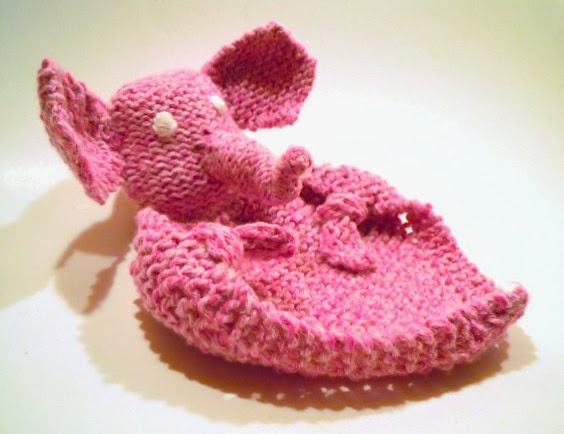
With Christmas coming, I've been looking around for things I could make fairly quickly. I came across a cute little knitted rabbit toy/blankie in the book 101 Designer One-Skein Wonders, so I decided to see if I could turn it into an elephant.

I won't post the pattern here, as the design is copyrighted, but if you're interested in the elephant adaptations I made, just send me a note.

This is the original "Blanket Buddy", designed by Mary Anne Thompson. It looks large in the photo, but the final knitted version is only about a foot square.


Using a chunky cotton-wool yarn, I began by knitting the body and arms. For those of you who speak knitting, it's a very simple garter stitch pattern with yarn-overs to create the holes, and knitted increases on each side to make the widening triangular shape. The arms are made with a series of cast-on stitches.


The head comes next, with the front and back knitted together, eventually forming a pouch. This was something I'd never heard of doing before, but it worked.


At this point, the original pattern tells you how to make the ears, knitting them right into the head before stuffing. The pattern suggests that you can adapt this to make different ears for different animals. Well, maybe if you were doing a cat or a bear instead of a rabbit. Not so much for an elephant. I tried to adapt the knitted-in ears, but I ended up with long floppy I-don't-know-what ears the first two times, and mouse ears the third time. I decided to regroup.

I began by stuffing the head lightly, remembering that it should be on the soft side for a baby. I then stitched the top of the head closed.


Next, I knitted a couple of ears by casting on six stitches, increasing gradually out to 14, then decreasing gradually back down to eight.

For the trunk—again for those of you who speak knitting—I cast on 12 stitches on double-pointed needles, knitting in the round for about 10 rows. I decreased gradually to six stitches, at which point I switched to an i-cord technique. Before attaching the trunk to the head, I stuffed it gently.


I attached the ears to the head first, as I thought this would make it easier to figure out where to put the trunk. After I'd attached the trunk, I added a few stitches to give it some shape.


To finish this, I stitched on some eyes with white yarn, and tied the arms in knots. And, because this is for a baby and will probably get a lot of wear and tear, everything is double-stitched.


When I was trying to figure out the ears, I almost turned this back into a rabbit, but I'm glad I persisted. The final is pretty cute in real life—and it's soft and cuddly, as any self-respecting blankie/toy should be.


Elephant Lore of the Day
I first told this story in the original Elephant a Day blog, but since it's about blankies for orphaned baby elephants, I thought it fit perfectly with today's post.

At the deservedly renowned David Sheldrick Wildlife Trust in Kenya, orphaned baby elephants are coaxed to feed by surrogate mother elephants—in the form of rough, grey blankets hanging from trees. Although to us these blankets look nothing like mother elephants, they actually serve an important purpose.

Baby elephants usually arrive at the orphanage following traumatic rescue from life-and-death situations. Distraught and frightened, they often succumb to pneumonia and gastric infections caused by stress. They also frequently refuse to eat. This presents a particular challenge for the people trying to save them.

It was discovered however, that if a baby elephant feels something similar to the texture of its mother's stomach when it reaches up, it can be coaxed to feed. Encountering large expanses of grey hanging throughout the bush, baby elephants will walk over to the blankets, touching them with the tips of their trunks in curiosity. Reassured by the texture, they will snuggle closer and run their trunks over the surface, just as they would do with their mothers in the wild. It then becomes easier to feed them from a bottle.


Baby elephant and grey blanket, David Sheldrick Wildlife Trust, Nairobi, Kenya.
Photo: Worldwide Features.com
Source: http://www.dailymail.co.uk/news/article-2115392/Baby-elephants-comfort-
blanket-How-huge-grey-rug-doubles-surrogate-mother-orphan-feeding-time.html


The babies remain dependent on the blankets for the first few months, then take the bottle without the blanket, then become tactile with the rest of the herd. When the elephants are between twelve and eighteen months old, they are moved to rehabilitation centres in Kenya's East Tsavo National Park, and are eventually released back into the wild.


Keeper feeding orphaned baby elephant at David Sheldrick Wildlife Trust.
Photo: Worldwide Features.com
Source: http://www.dailymail.co.uk/news/article-2115392/Baby-elephants-comfort-
blanket-How-huge-grey-rug-doubles-surrogate-mother-orphan-feeding-time.html


To Support Elephant Welfare


Sunday, 15 September 2013

Elephant No. 13: Small Knitted Elephant


I came across the cute little elephant below when looking for things to put on one of my Pinterest boards. I thought the use of i-cord (the tubular bits) was very clever, and decided I'd try to make something similar for today's elephant. To buy an adorable A Girl Named Leney original, visit her Etsy shop here.


Brilliant little elephant by Leney Breeden.
Source: http://agirlnamedleney.blogspot.ca/2012/05/knit-elephant-giveaway.html

I decided to make a green elephant today. I already had this fingering-weight yarn (about what you'd use to make lightweight wool socks or mittens).


With 2.5 mm needles, I began by making five little bits of i-cord for the feet, arms and trunk. There are a number of online tutorials on how to make i-cord, like this one. I don't knit like anyone I know, so me showing you how I knit would only be monumentally confusing.


I was going to write out my pattern, but it's not my design, so it felt wrong—and mine isn't as cute, anyway. I'm also terrible at writing out instructions for things like this, because I change my mind as I work. "Dog's breakfast" is a kind way of describing my working process.

Next, I knit up the body and head as one piece, and stuffed it lightly. I finished up the knitting by making up a couple of ears, then assembled everything to make sure the sizes were right.


I sewed the whole thing together. Definitely not as cute as Leney's original, but still pleasing to me.


I thought it could use a bit of colour, so I knitted up a four-inch (10-cm) scarf with garter stitch, using some hand-dyed handspun yarn I'd been given.


To finish the little guy, I added large seed beads for the eyes. I tried button eyes, but I didn't have any white buttons small enough, and didn't feel like going out to buy any. I also knotted a piece of yarn through the back for a tail. I think I'd braid it or something next time.


Looks a little bit like a Martian elephant, but I still like it. There's no way I'll remember exactly how I made the body and ears, so I may never make another one, but this single i-cord elephant makes me happy enough on its own.


Elephant Lore of the Day
Perched high up on one of the roofs at Notre Dame Cathedral, in Paris, is possibly the world's only elephant gargoyle. It's not a particularly scary-looking gargoyle, despite the fact that it appears to have claws.

Gargoyles are normally used to direct rainwater away from the sides of a building, either sticking out at an almost perpendicular angle, or draining water through a spout of some sort. This elephant fits neither criterion, as far as I can tell—although you'd think a trunk would have made an ideal spout.

I couldn't find any information at all on the origins of this particular gargoyle. Since elephants were not widely known in medieval Europe, this figure is likely a more recent addition, perhaps symbolizing anthropomorphized human characteristics such as strength, wisdom and power. Or perhaps it was placed there simply because someone liked elephants.


Elephant gargoyle on roof at Notre Dame Cathedral,
Paris, France, 2005
Photo: Lois Kosch
Source: http://www.pbase.com/image/43246323


To Support Elephant Welfare
Boon Lott's Elephant Sanctuary (Thailand)
Wildlife SOS (India) 
 
The Elephant Sanctuary (Tennessee)